
|
Nedra's Story
|
|
Preface.A tribute to Nedra N. Outlaw—our wife, mother, mother-in-law, grandmother—is presented here. She was our anchor; this tribute is to honor her memory, provide a legacy for her descendants, and we want you to know her better. We love her deeply and forever. In the first several sections, we highlight milestones, events and circumstances of her life. These sections comprise a chronological documentary; images are paired with the text. A navigation tool is provided at the end of each section allows a viewer to move among sections as desired. Later, ("Glimpses . . ."), we examine selected attributes individually as she expressed them over time. This is an important part. Glimpses also has a Snapshot subsection where random photographs are displayed. In this area, you will learn how she lived her life. Portions of the background information were written collaborative by Nedra and her husband, Bill, in stories for their children. Bill wrote most of the remainder with contributions by their children, Will and Elizabeth and their spouses, Christy Outlaw and John Crawford, respectively, and their granchildren, Christine Outlaw, Harrison Outlaw, and Kate Crawford. Assistance by Gemini, Claude, and ChatGPT is acknowledged; generative AI was not used for construction, alteration of or "improvements" on the images of people. This is a living document and will be modifed. Optimized for Chrome and for larger screens. This page is not designed to display responsively across devices. Continue by scrolling or select your next destination: Preface Deep Ancesry Early Life Elementary School High School University Bill and Nedra Meet Early Married Life |
|
Deep ancestry.High-schoo |
|
|
|
Elementary School.
In Nedra's words: "[The photo on the The photo on the right, above, shows Nedra with Merle (recall, her maternal grandmother), Dennis, and Mariah). Nedra took comfort in Merle's love for her and it is hard not to notice that Nedra is leaning into Merle. Nedra's brother Dennis L. Norton) became an architect, receiving his degree from Georgia Tech.
A few years later (near left), Nedra looks down approvingly on Brian as he celebrates his birthday. l-r back row: Betty, Judy Laird, Nedra, Mariah, Merle, Wendy Norton (in front of Merle), and Brian (seated).
(This section was written by Bill and is based on Nedra's reminesces.) |
|
High School.
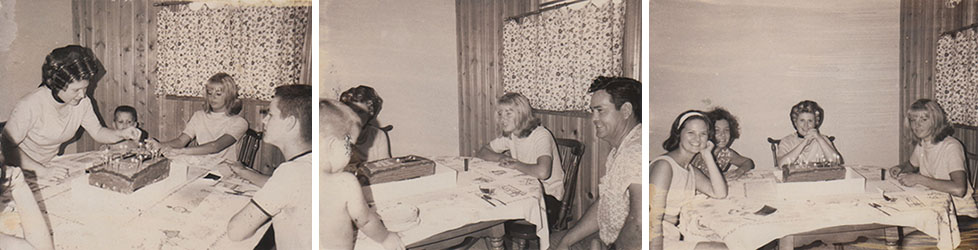
The image, left, portrays her as an apparently care-free teen. She was a reserved person—NOT aloof—and having this photograph taken of her seems delightfully out-of-character. She was a guest of Nada Fincher's family on a family vacation to Daytona and she appears to have gotten the most of it. Good going, Ned! (Nada was born and died within days of Nedra's birth and death dates. Nedra and Nada remained in occasional contact via social media.) The composite image (below) was from a spend-the-night party at the Norton residence when Nedra was 15. Left panel (l-r): Donna Blankenship, Brian Norton, Linda Hutson, Dennis Norton. Center panel (l-r): Brian Norton, Donna Blankenship, Linda Hutson, J. E. Norton. Right panel (l-r): Nedra Norton, Julie Davis, Donna Blankenship, Linda Hutson.
Nedra was a flutist her freshman year (far left) in high school and participated in several other activities, e.g. President of the Spanish Club, throughout the four years she was at Rockdale High. Judi xxx and Patricia xxx pose with her at a 1961 football game. Her prom photograph captures her essence. Her escort was Larry Cornwell, Senior Class President. I did not know Larry, but he is spoken well of; at this writing, 2026, he still lives in the Conyers area. By her graduation, her father had become a successful building contractor. Off campus, Nedra worked as a secretary in the engineer's office at Lithonia Lighting the summer after graduation.
Excerpts of selected comments—some posted publicly and others, privately to me—made by schoolmates after her death: "I loved hearing from Nedra," "her smile lives on," "always remember her smile," "wonderful person to know in high school," "sweet friend in high school," "beautiful woman," "so smart in high school." Photo Credits:The source materials were in Nedra's collection. (This section was written by Bill, with special thanks to Judy Bond for assistance with background information.) |
|
University.Nedra's story at the University of Georgia and our story together began in North Meyers (image below). We were introduced in the lobby (not shown), as discussed in the next section. (By the time that Elizabeth lived in Meyers, it had become co-ed. Times change.)
A part of Nedra's degree program required her to live in one of the four residential-style "home managment houses" on campus. Ann Kuzniak (two years behind Nedra) recalls: ". . . , home economics students were required to spend a quarter managing the houses, overseeing operations like budgeting, cleaning, preparing meals and hosting dinners. I Off campus, Nedra worked some at Kilburn's Day Nursery in Athens where she organized and supervised child play and at Elmore's in Conyers as a sales clerk during semester breaks. Data filed with the UGA Placement Office indicate that her interests were Art, Architecture (especially contemporary), and Fashion. Her hobbies were Drawing (drafting), Designing, Sewing, and Gourmet Cooking. The following sections allow assessment of how her interests manifested in adult life. Graduating from UGA at 22, Nedra was on the threshold of maturity. That sentiment was the impetus for portraying her at this critical time in a series of proofs, below.
Nedra did not have a car at UGA and was on a tighter budget than many of her friends. Upon graduation, her father bought her a new car with the proviso that she repay him for half. We did. Excerpts of selected comments—some posted publicly and others, privately communicated to me—made by UGA friends after Nedra's death: "a great lady," "I miss Nedra," "talented and wonderful person, "beautiful soul . . . class act,"very special friend, "I will always joyfully remember that lunch at SoHo with Nedra and Elizabeth," "one in 10 gazillion and made a lasting impression on everyone she met," "sweetest, most caring, loving person . . . big heart," "so creative," "one of a kind and one of the genuinely nicest people I have ever known," "so creative and accomplished," "kind and compassionate . . . admired her gentle spirit." Credits: FACS newsletter for Ann Kuzniak's remembrances. AOP website for image of the AOP house. UGA Housing for image of Meyers. (This section was written by Bill, and is supported by source material in Nedra's personal effects and discussions with Bill.)
|
|
Nedra and Bill meet.It took Fate a couple of tries to unite Nedra and me. Aunt Ellen (dec.)—Granny Della’s sister—married Reilly Hooper (dec.) from Monticello, GA, whose sister Lousie (dec.) married Robert Aiken (dec.). The Aikens had a daughter, Brenda (dec.) who visited Aunt Ellen’s daughter, Wynelle Dorminey (dec.), and thus Brenda and I met in Nashville. Brenda and I got together at the University of Georgia; she was one of the nicest people you could know. She set me up with a date with Nedra, who lived on the same floor in North Myers. Nedra was an incoming freshman then (Fall Quarter, 1966).
The photograph of her profile is the first that I ever made of her and it captures her joy in being reunited with me. She had not forgotten me either! I was lucky; she felt the same way and expressed it in an card she wrote for our 36th anniversary.
(This section was written by Bill.)
|
|
Marriage.We married on Monday, September 27th, 1971, and she died 19,692 days later, on Tuesday, August 26th, 2025. Marriages are not made in Heaven; they’re worked on here on Earth. This brief story is a summary of how ours began.
Art credit: Granddaughter Kate Crawford, then age 7, sketched and water-colored the Clarke County, Georgia Courthouse where the wedding took place. (This section was written collaboratively by Nedra and Bill.)
|
|
Early Married Life.
The right panel is a studio portrait made in 1974 before we moved to Lansing. She made the plaid outfit. A sewing-machine company gave a huge discount to home-economic teachers, enabling us to afford a top-of-the-line machine for her. This was the first of her three sewing machines.
Traditions were established in our early marriage that continued for the next 50 years. She took responsibility for my clothes--selecting, purchasing, making, maintaining &c. She laid them out on the bed every morning . We adopted a pattern of eating dinner together every night. And, those early busy days gave rise to our mega-meal tradition, i.e., preparation of food in large batches and freezing individual meals to be had later. Primitive at first (recyled TV-dinner trays heated in an oven), this tradition got us through hard times beginning in the early 1990s when she was physically unable to cook many days. Nedra also started managing my hair after she examined the job I got at "Jack's." Jack had gotten distracted and failed to cut the hair on one side of my head. :) Nedra and I enjoyed our time in Athens; we camped on the north Florida Atlantic Ocean (Kon-Tiki Family Camping Resort) and used it as a base to sightsee, get in the water, and for me, fishing on the bridge), camped in the north Georgia mountains, and lakeside near Athens. We were close enough to our parents to visit often.
It was time to move on to Ed Tolbert's lab in Lansing (next section). We sold the mobile home and almost everything in it and packed the remainder in a trailer (left). The disassembly of our home and packing put Meco in a high-anxiety state—she got as far forward as possible in the trailer and remained barely visible. She surmised that her future would be wherever the trailer went. What a dog. Bruder is being comforted by Nedra. After Nedra's death, one who taught Nedra at Rockdale High and subsequently taught with Nedra in Hartwell commented that Nedra was a "great student and great teacher." Photo credits: Hartwell County School system for her official photograph. A commercial studio made the portrait. Jackson Webster, our neighbor (and Bill's car-pool buddy) took the other photo. (This section was written by Bill.) |
|
The Outlaws move to Michigan, where Will was born.The Biochemistry laboratory of Ed Tolbert (dec.) at Michigan State University was a good place for me to get hands-on biochemistry experience (my degree work had been mostly mathematical modeling, and development of novel histochemical techniques, but I was well grounded theoretically in biochemistry and physical chemistry). Gemini describes Ed thusly: Nathan Edward Tolbert was a distinguished professor of biochemistry at Michigan State University and a member of the National Academy of Sciences. He was an internationally recognized pioneer in plant biology, most famous for his groundbreaking discovery of peroxisomes in plants and his extensive research into photosynthesis. After a two-day trip from Athens, Georgia (800 miles), our two-car convoy arrived in Michigan; we found a suitable house the following morning (July 2d, 1974) and moved in the same day (image, left). Unquestionably, the nominal 14 months that we were in Michigan were our leanest years financially. My "compensation" as a post-doctoral research associate, combined with the cost of two moves and Will's (uninsured) birth led to the assessment by AI that for the time and place, we were "economically strained or financially depleted." Yes. Nedra withdrew her retirement account from her teaching in Georgia and we sold her car. Several years passed before we were able to buy a home, and several more years passed before we felt relief financially. Nedra met the challenge head-on: she made all Will's baby food (and stored it in ice trays); she made Christmas gifts for the family, increasing the value of the gifts beyond the $7 limit we set; she bought from yard sales &c. and refinished old furniture to furnish our home; she (and I) carried a spiral notebook and recorded every penny of unnecessary spending, e.g. a soft drink, and limited this category to $35/month each. It was special when one or the other of us was able to treat the other out of their account. Notwithstanding our financial situation, she would remember this period as one of her happiest, hence this long account of a brief period. We had each other and were head-over-heels in love, had a suitable little nest, an extraordinary garden because of the deep soil and long days of southern Michigan, and a plan. Nedra's move to Michigan isolated her from all she had known aside from her nuclear family. Fortunately, she was busy with preparing for and tending to a baby and other activities. Also fortunately, Linda Campbell moved in just down the street from us the same weekend as we moved in. Linda had a small child, Lisa, and her then-husband, Bill (dec.), had just started a post-doc in Tolbert's lab also. Thus, Linda and Nedra supported each other, went to yard sales together, &c. I had known Bill from his first post-doc with Clanton Black, (the chairman of my reading committee). Bill and I also socialized, e.g. canoeing the Flat River, and we were in contact until he died. AI describes Bill: Wilbur H. Campbell was a prominent Michigan Tech biochemistry professor and a pioneer in plant biology. He is internationally recognized for his foundational research into nitrate reductase and sustainable water testing chemistry. AI describes Lisa: Lisa Carne is a pioneering marine biologist and the founder of Fragments of Hope, a community-based nonprofit organization in Belize that spearheads the most successful coral reef restoration project in the Caribbean. Fifty years ago, a baby boy was born in Sparrow Hospital, Lansing, MI, to Nedra and Bill Outlaw. His given names were a combination of family names [William Henry Harrison “Dick” Outlaw (1840-1910) → Lucious G. Outlaw (1873-1918) → William Henry Outlaw (1912-1986) → William Harrison “Bill” Outlaw Jr. (1946-)] plus [Mark R. Watson (1816-1898) → Samuel W. Watson (1863-1925) → Mark A. Watson (1896-1959) → A. Christine née Watson Outlaw (1918-2001) → William Harrison “Bill” Outlaw Jr. (1946-)]. W.H.H. Outlaw was born a year before the short presidency of William Henry Harrison. Harrison’s popular fame was based on his military career, esp. his defeat of Tecumseh’s confederacy (though Harrison had political experience as early as the 18th century). Harrison’s father had been a revolutionary soldier. Harrison’s profile likely appealed to W.H.H.’s father, Alexander, who had been an “Indian fighter” and whose grandfather Benjamin was a revolutionary soldier. I do not have reliable information concerning the origin of Mark R. Watson’s given names; possibly the R. is for Rouse, which is maybe his mother’s maiden name. Likely, Mark R. was illegitimate. Patsy had children by several men and was kicked out of the church for adultery. Of course, “Mark” was altered to Marcus to fit our tastes.
Photocredits: Nedra and Bill's collection. (This section was written by Nedra and Bill.) |
|
The Outlaws move to Missouri, where Elizabeth was born.Add: photo of Hedgerow, also bonfils photos of E The Pharmacology Department at Washington University School of Medicine, led by Oliver H. Lowry (dec.), was the unique place to combine my skills in quantitative histochemistry of leaf tissue (gained at the University of Georgia) and practical lab biochemistry (gained at Michigan State). Indeed, I had corresponded with Dr. Lowry, Dr. Tolbert and one other while I was at Georgia with the plan of working with all three at some time. Dr. Lowry is described by AI: "Oliver H. Lowry was a Washington University biochemist who made major discoveries about metabolic regulation, particularly glycolysis in brain. With Janet Passonneau, he identified phosphofructokinase as a principal control point of glycolysis and elucidated its complex allosteric regulation. He also pioneered ultramicrochemical methods that permitted biochemical measurements in microscopic tissue samples. He was a member of the National Academy of Sciences." Unfortunately, even most scientists know him from his protein assay, the most highly cited paper ever. I would also add that he was an able administrator, an excellent mentor and a decent person. Nedra's and my financial situation stepped up a notch at Wash U as my appointment was as a Research Instructor (faculty status); in practice, that means little, but we welcomed the extra money.
xx |
|
The Outlaws move to Florida, where Bill had a 30-year career at FSU.ADD: chelmsford, E w T, W in baseball, church Excerpts of selected comments from various sources after Nedra's death made by FSU associates and others who knew her when she lived in Tallahasse: "I remember a pow-wow we had in your office many years ago. . . . I had considered [], but you told me you had found yourself in a similar situation and Nedra had counseled you [and you followed her advice]. I have carried this with me until this day." "wonderful person," "what a great person," "I recall my parents saying how much they had enjoyed spending time with Nedra," "such a kind and wonderful woman," "I spent so much of my childhood in their home. She always treated me like one of her own," "wonderful mother and grandmother," "truly lovely lady," "loved her. . . . one of a kind and world could use more like her," "always the kindest and sweetest woman. She always made me feel welcome in her home," "gentle disposition," "Few people will experience the love and support you had for each other," "a beautiful soul and your perfect partner in the life you had built together," "truly a special woman," "sweet lady," "principled woman who made life better for others," "admirable life you built together," "very special woman," "sweet and gentle person; I will miss her dearly," "wonderful person," "beautiful person." |
|
Will and Elizabeth Became Established.Nedra was our Chief of Staff and the co-author of our lives. Every day, she guided us, supported us; we were her raison d'être. This section is to credit Nedra, but it is praise that could be written of many parents, grandparents, guardians and nurturers whose loved ones took different paths. We honor them all. As mentioned below, both Will and Elizabeth returned to their mom's open arms after college as they prepared for the next steps in their lives. Their paths were consistent with the advice I gave them, viz. to become educated in a topic of interest and then gain the skills needed to earn a living and serve society.
Photo credit: The images were provided by Elizabeth and Will. (This section was written by William and Elizabeth,with assistance by Bill.) |
|
Marriage of Children.Milestones in Nedra's life, like their becoming established, include the marriages of her children.
Will and Christy Hill married in 2017 at Autumn Creek Vineyards. The image at far-left shows the couple along with Will's children, Harrison and Christine. The warmth in the embrace, left, of Will and Nedra is striking.
Photo credit: The images were provided by Elizabeth and Christy. (This section was written by Elizabeth, Will, and Bill.) |
|
Nedra's Grandchildren.Nedra was the consumate grandmother, doting, nurturing, assisting, entertaining.
Christine remembers Grandmommy as caring, selfless, always putting others above herself, thoughtful, and with a special talent for decorating. One of Christine's fondest memories is of the two of them sitting in my office after Nedra's first stroke. Christine had helped her dress on this last visit and felt closest to her then. Nedra was trying to act as if all was normal; her stoicism was characteristic. In addition to being a student, Christine works as a waitress and enjoys reading and swimming. She is preparing for a career in acting or marketing.
In addition playing soccer, Harrison also referees and he works in a pizzeria. Otherwise, he enjoys his independent study of Spanish and studying science in his spare time. He would like to train as a chemist or biologist in university.
Like her grandmother, Kate enjoys cooking (image taken at the farm) and arts and crafts, and they often did both together. Nedra spent much time and thought researching shared activities and materials they could do during family visits. Kate describes Nedra as kind, creative, loving, passionate, and joyful. Kate is now a middle school student at Friends School of Wilmington. She loves animals, hopes to become a marine biologist, and enjoys swimming, surfing, basketball, making pottery, and fashion. (This section was written by Nedra's family.)
|
|
Glimpses of Nedra's Life.Attributes. Recall that Nedra's development into womanhood and milestones of her life have been the foci of previous sections. In this section, we will remember Nedra's day-to-day activities with vignettes typical of her life. Redundancyis a feature of this essay.
(This section was written by Bill.) ---------------------- Nedra showed respect for her acquaintances and associates. The same genuine spirit that dogs recognized made Nedra cherished by people who knew her well. This was especially true in the intimate environment of our research lab, where her presence was felt. ---------------------- Nedra supported my career. During that era, spouses often directly contributed to the success of their academic partners. Notable examples from my own workplaces included Matschinsky (Pharmacology at Washington University), Templeton and Varner (Biology at Washington University), and Hofer and Graziadei (Biological Science at Florida State). Simply put, I could not have succeeded without her devoted assistance, which was largely off-site and uncompensated. She critiqued every manuscript and grant proposal that left my lab, and routinely reviewed my exams and other materials. Her extensive support began when I was working full-time in the Biochemistry Department at MSU; during this period, I needed to write a proposal to secure my future work at Washington University. She searched, collected, and sorted all the necessary literature—an invaluable effort in the era before computerized searches. With that foundational start, I utilized my weekends to assemble the proposal.
A tangible example of her contributions is the line drawing (image at left) used in a grant proposal to document that my facilities were sufficient for the proposed work. Like Nedra herself, the drawing was supportive without pretension. Nedra could have been a draftsman. (This section was written by Bill.)
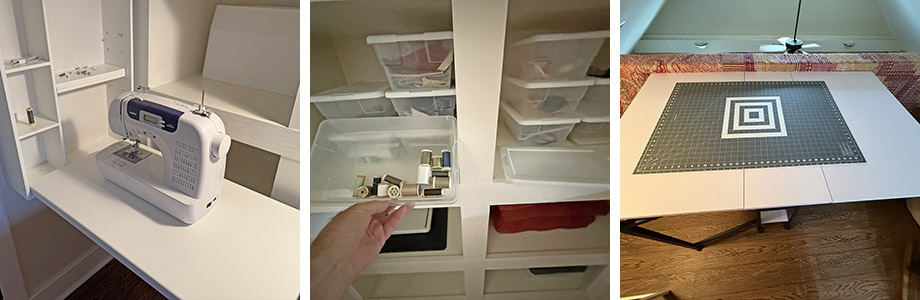
---------------------- Nedra was a professional-level seamstress; she was skilled and it was one of her passions. A glimpse into her main sewing area is shown below. Left, her machine is exactly as she left it--her last use was apparently in making adjustments to the machine as it was partially dissembled (thread tension always required attention). Located on the second floor by double windows, she could watch over a wild area, which she enjoyed. Middle, a portion of her organized supplies in a closet. Right, her layout table was in an adjacent area.
A glimpse into her satellite sewing area is shown below. That location was less spacious and its purpose was adjusted according to demand. Left, her machine was used on a wall mounted cabinet with a drop-down top. Center, her supplies,, were directed to the current project. Right, her layout table was collapsible and not shown fully extended. These images were staged.
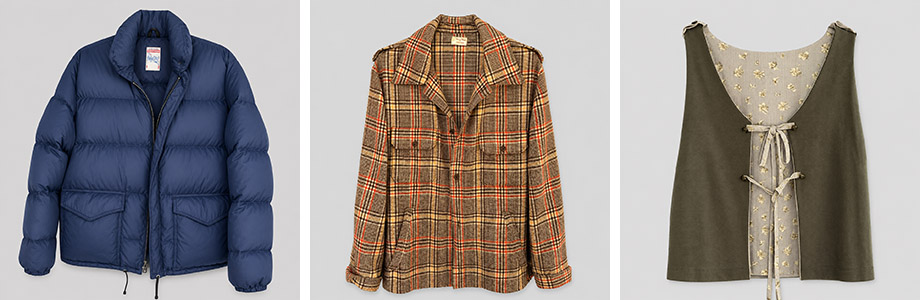
Nedra worked on a range of projects from lingerie to curtains to wall hangings to pillows and so forth. For brevity, only three graments are shown as examples. These garments are made from different fabrics and their constructions spanned several decades. Left, the second down jacket that she made for me from a Frostline kit. (Frostline products appealed to DIYers and no longer exists; they provided supplies and skilled customers could save ~50% compared to pre-made jackets.) Center, another garment she made for me. Observe how carefully the patterns are aligned. Third, a sleeveless vest she made for herself. There was no room for error--it was sewn inside out and on a curve. Flawlessly
(This section was written by Bill with assistance from Elizabeth).
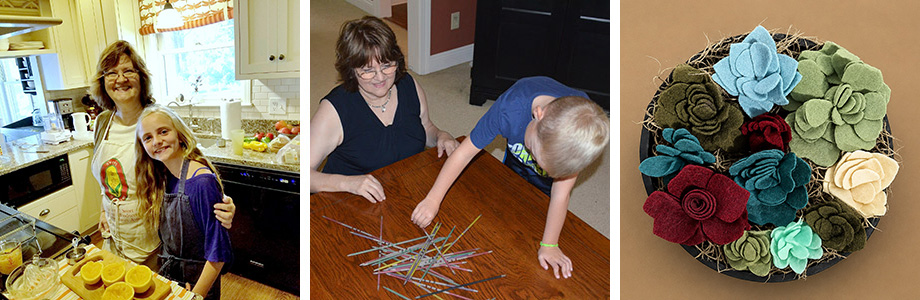
---------------------- Nedra was the consummate home decorator. xxx pHOTOGRAPHS of HOUSE CONSTRUCTION, STENCILING, REFINISHED FURNITURE (IF i CAN FIND IT) ---------------------- Nedra was fond of wild flowers. xxx pHOTOGRAPHS her planting wildflowers, of various wild flowers she loved ---------------------- Nedra was born to nurture. Nedra always planned for activities with the grandchildren (and—on occasion—for the grandchildren, assigning me a role like running through the sprinkler with a two-year-old). Left. Nedra was as eager to teach the children to cook as they were to learn. On this day in 2016, Christine and cooked together. Center, Nedra and Harrison play a game of pick-up. Right, Nedra's last craft project was with Kate when they made this felt floral display.
------------------------------------------------- Snapshots. Visits with former lab mates from the University of Georgia in 1976. Left, Don Fisher (dec.), my major professor, and Nedra at the Missouri Botanical Garden. We were privileged to host Don several times after he moved from UGA to Washington State; he and I collaborated several years after our mentor/student days. Our connection was greater than merely academic; after his death, he son indicated in a letter that the Fishers considered me part of their family. The Missouri Botanical Garden in St. Louis is a historic 79-acre urban oasis featuring the iconic Climatron geodesic dome conservatory and one of North America's largest Japanese strolling gardens. Out of pubic eye, it operates one of the world's most active research and training programs in tropical botany, anchoring its global conservation efforts with an herbarium of approximately 8 million plant specimens—the second-largest in North America. At the time, my colleague Peter Raven was the director. Center, Pat (dec.) and Larry Christy and Nedra holding Will at Cahokia Mounds. Early in our careers, Larry and I collaborated (he, quantitative histochemistry; I, mathematical modeling) and we have remained life-long friends. Thanks, Larry. AI indicates that Larry revolutionized the study of carbohydrate translocation by developing the first comprehensive mathematical treatments and computer simulations that validated Münch’s pressure-flow hypothesis of phloem transport. Later, Larry was hired by Ernie Jaworski (dec., Director of Biological Sciences and known for his role in glyphosate) of Monsanto; Larry worked his way up to Group Leader, then founded his own company. Cahokia Mounds is the largest pre-Columbian archaeological site north of Mexico, featuring massive man-made earthen mounds built by an advanced Mississippian civilization. Right, Nedra and Bill pose with Tom (dec.) and Peggy Housley in New Orleans in 1976. Tom--whom I liked without limit--and I were fellow graduate students and more (e.g., he and I hiked/camped on a small part of the Appalachian Trail). AI indicates that Tom advanced our understanding of crop physiology by mapping carbon partitioning, phloem translocation kinematics , and the physiological defense mechanisms crops use against parasitic weeds. Tom was also known for his work with 11C, a strong emitter, but with an inconveniently short half-life.
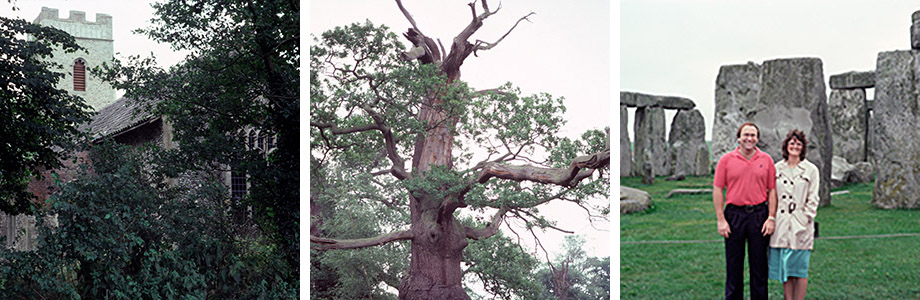
******Insert photo here after scanning & center separator below. --------------------- Trip to the United Kingdom in 1980. Fortunately, Nedra was able to travel extensively in the 1980s because her decling health robbed her of later opportunities. Over the course of a year, Nedra meticulously planned and coordinated the logistics of her first international trip, which was to the U.K. She took into account her, our, and my interests, examples being in the images below. Left, St Faith's Church in Little Witchingham is a remote 14th-century Anglican parish church in Norfolk, England, widely celebrated for its remarkably well-preserved collection of vibrant medieval wall paintings. When we visited (Aug 13,1980), it had been abandoned (indeed, part of roof was missing); I gained permission to visit from a local rector before our trip. Unkept vegetation and trees prevented a good landscape image. It is now a museum with regular hours--as it should be. My 8th greatgrandparents, Lord Ralph Outlaw and Elizabeth Kempe were married here in 1615. Center, Sherwood Forest is a historic royal hunting forest in Nottinghamshire, England, world-famous for its ancient oak trees and its legendary association with the folklore of Robin Hood. People who know us would know why we visited. Right, Nedra and I pose at Stonehenge, a prehistoric monument in Wiltshire, England, consisting of a ring of massive standing stones constructed between 3000 BC and 2000 BC, universally renowned for its mysterious origins and precise alignment with the midsummer sunrise. (Other notable locations she visited included London; Cambridge University; a visit with Terry Mansfield FRS, Lancaster University; Beatrice Potter's 17th century farmhouse; a milecastle on Hadrian's Wall, a dinner w Prof. and Mrs. Hans Meidner (dec) FRSE including a guided tour of Sterling Castle; Glasgow; Bath (Roman baths); Salisbury Cathedral; site of the Battle of Hastings and nearly a week in Bristol.)
--------------------- Self-guided tour of Greece. 1985. An arrangement was made with a tour company in Tübingen for air travel to a rural area on the northwest coast of the Peloponnese and for lodging at the Kalogria Beach Hotel
. We devised our own itinerary and a "tookey Suzuki," confining ourselves to the Peloponnese with a single exception, an excursion to Delphi. The Peloponnese,
a large, rugged peninsula in southern Greece
packed with world-famous ancient ruins, charming coastal towns, and steep mountains, could occupy a serious visitor to a long time; we only sampled a small part. For the purposes here, I will display only three images, which I think were among Nedra's favorite memories. Two of the images were experienced on a day trip to Lapanagoi (Lapan) on 17 Jul 1985. Lapan, an isolated mountain village, has mostly vanished now, but at the time we visited, it still had a population of 30-40 residents, mainly aging farmers and shepherds. Gemini's description was relatible: "Reaching Lapan in 1985 was an arduous adventure. The dirt access road from Kalavryta is rocky, deeply rutted, and frequently washed out by winter mudslides, requiring a sturdy 4x4 or a dependable donkey." We sought a step back into time and we found it. The 3d image was from visit to Olympia, modern and ancient, on Jul 20 1985. Ancient Olympia was the sacred sanctuary in Greece that hosted the original Olympic Games every four years for over a millennium when it was banned by Rome in 393 AD. After that, the site was buried by silt until its 1776 rediscovery. Standing there, the sheer scale of that history was overwhelming. Left. Nedra enjoys the ambience of the small restaurant in Lapan. We were the only customers but the owner and two friends were socializing in a convivial atmosphere. Center. In traditional style, we were led to the kitchen and made our selections at the stove. Something magical clicked. Will and Liz completely endeared themselves to the owner, and he, them. It was a marvelous time and when we had to leave, the owner followed us out, crying as he waved goodbye. The children with their noses to the back window reciprocated. This was an experience that cannot be planned and money will not buy. I am so glad Nedra had it. Right. Elizabeth crosses the finish line on the ancient track at Olympia before Will does! There's more to the story; it was a race only because Will allowed it to be. He ran a few paces ahead of her and planned to win. Near the end, some tourists walked directly in front of Will, holding him up. He was unable to make up the lost time, and, indeed, Elizabeth won.
----------------------
The Leborgne family, with whom Nedra became friends during her visit with Elizabeth, visited us in Tallahassee in 2001. The image, taken in St. Augustine, is of Elizabeth, Nedra, Mme. Leborgne (front row) and the Leborgne sons (second row). ----------------------
Nedra was supportive of my life-long passion for producing food. She used her imagination and talent to make me feel special; examples are shown in the 3-panel image below. Left, the "cabbage cake" is modeled after my garden (early 1990s). The rake came with a "smoking man," a gift from my host at Munich Technical University. Center, Pear (cv FlordaHome) and Fig (cv Hunt) tart, made from our fruit in 2013. " Crostata di Fichi e Pere ," a Tuscan recipe inspired by our visit with Gianni Bedini, Director of the Botanical Garden in Pisa. This dish has a deeper meaning to us as Nedra accompanied me when I visited Ralph Sharpe (dec, who bred FlordaHome) and his spouse, Becky. Hunt fig, it is said, was the first intentionally bred fig (at maturity, the stem bends so the ostiole of the syconium is on the bottom, an attribute that might delay spoilage). One day long ago, Nedra and I made a superficial and unsucessful attempt to learn more about Hunt, the man, in Eatonon. Right, Zabaglione, aka Zabaione is another Italian dish. Nedra made this one from our fresh blueberries and our blueberry wine.
---------------------
all of germany is in the index- card stage. Germany. my prem notes: Gräfelfing is an affluent, upscale suburban "garden town" on the western edge of Munich, renowned for its elegant, single-family villa architecture and leafy residential streets. Munich Technical University (known today as TUM ) is a premier, world-class research institution whose historic main campus sits right in central Munich’s museum district, famous for its cutting-edge engineering legacy and distinctive modern-meets-classical architecture. The Ziegers (dec) discovered indirect postranslational reversible activation of a plant enzyme (~1965). Without belaboring the details, the enzyme catalyzes the reductive step in photosynthesis and its activation is based of the reduction of a disulfide bridge to sulfhydrl (cysteine to cystine). Pfäffingen is a quiet, historic Swabian village situated in the scenic Ammer River valley near Tübingen, characterized by traditional half-timbered houses and surrounding agricultural orchards. Tübingen is a historic, quintessential German university town on the Neckar River, celebrated for its beautifully preserved medieval Old Town, steep cobblestone alleys, and traditional wooden punting boats. Eberhard Karls Universität Tübingen ) is one of Germany’s oldest and most prestigious universities, founded in 1477, whose historic departments, libraries, and student life are seamlessly woven directly into the medieval fabric of the old town. More than Germany Battle of the Bulge Memorial (Mardasson Memorial), Bastogne, Belgium
Nedra at 30 Left, Nedra and Belle are chilling together; they were best friends. Center, For decades, our family vacation xxx USS Alabama, Lake of the Ozarks, Washington State Park Nedra at 58. Left, Nedra and Belle are chilling together; they were best friends. Center, For decades, our family vacationed near Mt. Rest, SC, each fall. Usually, we lodged in a CCC-built cabin in the state park. Center, Nedra is shown hiking (with Elizabeth and me) on the King Creek Falls hiking trail, which winds through hardwood forests and rhododendron tunnels inside the Sumter National Forest to reach a spectacular 70-foot tiered waterfall. Right, as Elizabeth's guest, Nedra is standing on the porch of "The Barn," P. Buckley Moss's historic home and studio in Waynesboro, Virginia. (Nedra accompanied Elizabeth as Elizabeth toured universities to decide on her next step.)
---------------------
Credits: The source materials were in our family's collections. (This section was written by Bill, with internal acknowledgements to other contributors.)
|
|
| Buck | |
Decline in Health, Death, and AftermathHealth problems limited Nedra throughout much of her life, especially from the early-to-mid 1990s, when she was diagnosed with fibromyalgia; several local rheumatologists treated her, and one later added a diagnosis of lupus (but, I think, unproven). Her health varied — periods of relative wellness alternatated with periods of significant impairment. It was not her nature to complain or create drama, so most people did not know. Notwithstanding, the seriousness was underscored when she was denied long-term-care insurance.
The family memorial.
Will was the officiant and delivered these comments: "Dear Mom,
"We come here to celebrate your life. Although you left this Earth the early morning of Tuesday, August 26th, 2025, your memory lives on, now stronger than ever. Throughout the course of your life, you deeply impacted the lives of countless people. We are proud that you graduated from the University of Georgia with both a Bachelor's and Master's, a notable achievement for a person of your generation.
"While you were at UGA you met your husband, my dad. A few years after your marriage, I was born and, Mom, you made the ultimate sacrifice of giving up your teaching career to take care of me and, three years later, my sister. You prioritized your family's needs over yours.
"With the benefit of hindsight, it is clear that I lived a privileged childhood. Neither my sister nor I wanted for anything. Yet it was the individual attention I received at home, beginning with you, Mom, that most profoundly impacted me. You were omnipresent. You assisted me with my homework, took me clothes and grocery shopping, drove me to friends' houses and my sports games. Much more importantly, you simply spent time with me, asked me about my day, nurtured me, encouraged me. You never yelled at me, spanked me, or said a cross word to me in the course of my life . . . although there would have been countless justifiable reasons to have done so. Indubitably, Mom, I owe much to the childhood I was afforded by your making so many personal sacrifices.
"Mom, I am grateful to have been able to share so much with you, yet I'm inconsolably grieved by your unforeseen departure and my inability to prevent it.
"Mom: you and dad were the one constant force during my first 50 years on planet Earth. Through the ups and downs of childhood, during the joys of infancy and the trials of adolescence, across the struggles of early adulthood and the transition to fatherhood, you were always there. But now half of that inseparable duo is gone. The adjustment to life without you has been difficult and will leave an irrevocable void.
"Yet with time we do our best to move forward. Not because it's easy, not because we want to, but because we have to. So now I find myself navigating the stormy waters left in the wake of your demise; my father, wife, sister, and children the only life jackets without whose support I would have surely already drowned.
"Mom: Only by looking back fondly upon our countless joyous moments together can I even begin to soothe the grief and the emptiness left by your absence. Moments such as the seemingly never-ending afternoons after school you spent reading to me and Liz—these are never-ending bright spots indelibly imprinted in the deep recesses of my brain. Such pleasant afternoons those were, during which one book would become two, and from two, three, and from whose embers were kindled my ongoing passion for reading!
"Mom, you were a great couponer and went to great efforts to save money for the family. I still remember how you meticulously collected and organized the coupons in a shoebox. Liz and I would accompany you frequently to the store (usually Albertson's), shoebox in tow. I still remember the smell and taste of the black-and-white Albertson's cookies, a delicious bakery treat that capped off most visits.
"On one such shopping trip, I remember accidentally dropping the shoebox, spilling the entirety of its contents on the floor. I think of my current adult self and quickly realize I would not have handled this situation nearly as well as you did, Mom . . . you simply picked up the coupons from the floor, having not uttered a single harsh or ill word toward me.
"Mom, there never lived a more tolerant soul than you. Many a day after school was spent with you on 'urgent' school supply shopping for projects that I decided to complete at the last minute . . . or in a rushed search for friends' birthday presents whose party invitations I received weeks in advance but somehow forgot to inform you about. A planner by nature, Mom, you never let my faults get in the way of your taking care of me with the utmost kindness, tenderness, love, and respect.
"Mom, you have now left Earth, but our presence here is testament that your spirit endures. I know you have found peace now, free of the joint pains and fatigue that plagued much of your life. I know you are looking down upon us, smiling.
"Every day I can still feel your presence guiding me as I trudge my way forward through life, trying to be the best person I can, in a feeble attempt to be half the person you were.
"Mom, I love you. You sacrificed so much for all of us here today. I hope we have made you proud."
Bill left this message with Nedra's cremains: "Beloved Nedra,
"I’m not okay; things are not going well. I never knew what misery was until I lost you. More than nine months have passed since your death, and I sit crying as I do almost every day. I love you so, so much. You will never be sad or in pain again and I am grateful. I would readily change places with you except the thought of your enduring my pain is too much.
"You left us against your will and ours. You were brave during your prolonged and most recent illnesses. I feel so much guilt that I could not save you. I tried so hard and did the best I could on the basis of what I then knew. I will remember so painfully when I had to authorize having you restrained. I did not know a better course. I will remember so painfully when I gave the order to have life support removed. I know this is what I would have wanted and am certain that you would too. But, I am still so, so sorry. I am also so sorry that I did not think to tell you that I love you for the last time as you lost consciousness in my arms.
"I am without words to express my gratitude for having you during my life. I hope you knew that. As I’ve told you many times, for me, it was love at first sight. You helped me become a better person. Thank you for seeing enough in me to take the chance. And, thank you for your advice, your counsel, your guidance. You were, as Elizabeth remarked, our keystone—we all were stabilized by you.
"I’m doing my best to hold my head up and walk straight, but it is dishonest. I try to find something of interest, but the spark is no longer there. When you died, I lost my reason for living. I keep slugging only because of the children and what I need to do for them.
"As mentioned, the nine-month mark has passed and, no, I am not moving on. There’s no place I want to go except to be with you, and that is impossible. I wake up thinking of you, I go to bed thinking of you, and during the day, I think of you. I dream of you. I hallucinate and see you and hear you. I long to touch you. I want to help you however I can. You’re gone; it’s all in my head.
"I’m trying to do right by you. All your personal effects are being distributed to others as I think you would want. Will and Eliz have wanted most and they have been generous in their interactions. You reared them well and it shows. Liz is getting your pearls from Hong Kong, so she will pass hers to Kate; they’ll be a mother-daughter match like you and Liz were; Will is getting your ivory necklace from South Africa. I am keeping your wedding bands by our bed. I am trying to move along with the plans I discussed with you. It will take a couple of years to get the house at Turkey Run prepared for sale and I dread losing it as it will mean losing part of you all over again, but my situation is not sustainable. I miss so much your guidance and counsel. I need you to tell me what to do.
"You will always be my wife and I keep you everywhere as I told you I would. Three pairs of your shoes are under each of my beds. You always belonged in the bed with me. A bobby pin, here, and other mementos, there.
"In writing your tribute and for other reasons, I have looked back at our life together. You were not simply remarkable, you were sensational. You prepared your children for their future. By hard work, you maintained your beauty and elegance as you aged. You created a warm, lovely home and maintained our love so that it reached its zenith near your death. The list and my admiration for you could go on and on. I had a gem of a wife, and I know that more than ever now. I wish that we could meet if only for an hour so I could praise you, but “til death do us part” has come and gone. Your story has ended, but it will be remembered and repeated over and over. I am proud to be your widower, as I was, in your words, “my Bill.”
"With all my love, forever,"
Elizabeth prepared this message for interment with her mother: "Dear Mom,
"It doesn't seem possible you are not here with us. I equate 'family' and 'home' with you. I try to focus each day on my gratitude for how fortunate I was to have you as my mom, but it is hard. Nothing could have prepared us for the depth of pain and grief we feel losing you. You were and are everything to us. I hope you knew that.
"I will miss knowing you are always there as a loving, kind, nonjudgmental, and supportive presence in my life. I will miss the feeling of coming home, wherever we are, to your warm hug and love. I will miss your smile and your laughter. I will miss your softness. I will always miss you and love you forever.
"Love,
Your Daughter" Passages from a letter written by Christine and buried with Nedra's cremains: ". . . I hope you are someplace safe and happy. The impact you made on everyone in our family is inspirational. Granddaddy loves you more than anything on this Earth. The love between you two and the way he fought for you is something everyone deserves. I hope I am lucky enough to experience even a fraction of the love you guys shared.
"Throughout your life, you were a beacon for everyone—Liz, my dad, Granddad, and us children. Thank you for being such an amazing chef, baker, fixer, mother, and grandmother. . . . I hope you know how much I care about and love you, and how much you inspire me. Stay safe up there.
"Love,
Julia Christine" Harrison committed this message with Nedra's cremains: "We miss you. Something that we all have had to realize suddenly is that you no longer are here. It's difficult for all of us, especially Granddad. I hope there are ways for you to know how much love we have for you, and how it will never fade.
"I'm lucky that I had such a great, loving, and caring grandmother like you to tell my kids about one day. You'll never be forgotten, and you'll never stop being loved.
"Harrison"
Kate enclosed this message: "I miss all the interesting conversations. You taught me many cool things, like how to sew, and I am forever grateful for that. Miss you so much."
— Kate
(Note: Via her mom, Kate has one of Nedra's machines.) John wrote this note for burial: "From the first day we met, you were always kind, welcoming, and thoughtful. You always considered others first. Your kindness and warmth are truly special and rare. I will always remember how you made me feel special. I also enjoyed all our conversations about art and crafts. It was a love we both shared. I love you and miss you!" We were all devastated by Nedra's illness and death. I exhibited symptoms consistent with Broken Heart Syndrome (Takotsubo cardiomyopathy) and my Apple Watch recorded quantifiable correlates--insomnia (a weekly average of less than 4 hours of sleep at times), cardiac arrhythmia (which had been controlled by the ablation in 2023), hypertension (which required tripling my medications), and a precipitous decline in heart-rate variability from an excellent-for-my-age 60 ms (weekly average) to 31 ms (weekly average). I also exhibited symptoms not recorded by my Watch, viz. severe brain fog (I got lost on the farm one day, and I could not remember 6-digit verification codes), paranoia, indescribable depression and hopelessness, all of which likely can be attributed to changes in hormones (sustained spike in cortisol, which sets off a cascade of changes in other chemicals). I went back-and-forth through the stages of grief that I have read of (denial, anger, bargaining, depression, acceptance), and I fought irrational thoughts. One hundred and sixteen days passed before I had any relief, even a glimpse of joy (when Leon Sutton hosted Will, Harrison and me on a visit to the Buck Sutton New Homeplace). Thanks to time, support by Will, Elizabeth, and others, I have integrated my grief at the one-year mark. I am still on elevated medication for hypertension, still have not fully recovered my mental acuity and still have challenges regarding my second sleep phase (I have been a biphasic sleeper for decades). I understand that the period of increased mortality risk from Broken Heart Syndrome is generally measured in weeks, so I have passed that, with reservations. I assess that I am vacillating between the final two stages of the Kübler-Ross order, above. I have no desire to "move on" or "get over her death." Her shoes are under my bed, as I told her that they would be, and they will remain there. I clutch her jewelry at night, and I will continue. She was my forever wife.
Excerpts of selected comments--some posted publicly and others privately communicated to me--made by family, friends and others after Nedra's death: "we had a bond," "sweet, kind lady," "intelligent woman," "special person," "beautiful woman, partner, wife, mom, friend," "beautiful lady," "exceptional person and very talented," "remarkable person," "beautiful lady," "special lady," "I admired her calm and graceful way of speaking and her many talents, especially interior decorating."
Photo Credits:The source materials were in Bill and Nedra's collection unless otherwise noted. (This section was written by Bill, with internal acknowledgements to other contributors.) |
|
|
|
|
| Buck | |
| Buck | |
| Buck | |
| Buck | |
| Buck | |
| Buck | |
| v | |
| Buck | |
Return to Documentation for this page. Return to Image Workshop home. Return to Southern Matters home. |
|
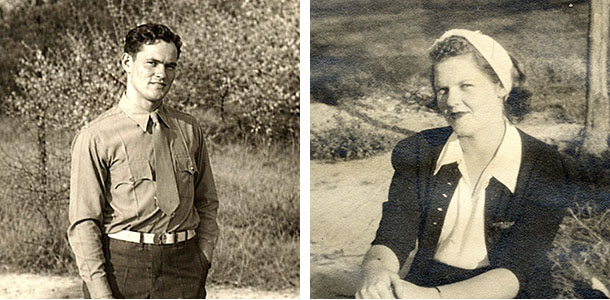 Nedra was the first-born of barely 17-year-old Betty Joan Norton née Laird (1931-2002) and 24-year-old James Elisha (“J.E.") Norton (1923-1995). She made her debut at the hospital in Porterdale (Newton County, Georgia); at the time, there was no hospital in Rockdale County. Betty, listed as a housewife on the birth certificate, was born in Rockdale County and took her mother's maiden name because her father's name was never disclosed by Betty's mother, Merle (1910-1991). Her Laird family had been in Georgia since the first quarter of the 19th century. J.E., listed as a carpenter on the birth certificate, was born in Jefferson County, TN, where Nedra in her youth noted the poverty of relatives when she attended the funeral of her greatgrandmother Kate Lane née Phillips (1881-1957). From public records, we find that J.E. completed the 7th grade, had only worked 26 weeks in 1939, but got on with the CCC by the 1940 Population Census; possibly, J.E. learned his carpentry skills in the CCC. Later records show that he spent 1941-1945 in the Marine Corps (Corporal, field artillery), where he participated in the horrific campaigns of the Pacific, APO San Francisco. He indicated on several occasions that he engaged in combat at close quarters and recounted an instance in which a dying man he shot pulled out a photo of his wife and showed it to J.E.
 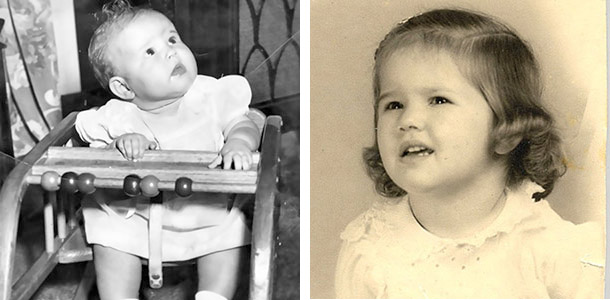 Nedra Lynn Norton was delivered by Dr. Joe Brown; later, he had privileges in Conyers in a new hospital. During Nedra's youth, he lived in Conyers (13 miles from Porterdale). Nedra's first given name was selected from an announcement in one of the Atlanta papers; likely, Georgia-born Nedra Tyre, an author and social worker, who published Red Wine First in 1947, was the inspiration. The 26 chapters in this book comprise autobiographical sketches of disadvantaged people and that probably resonated with Nedra's parents. Lynn was simply a common girl's name then. Nedra's grandfather Alva Arthur Norton (1894-1980), a partially disabled victim of mustard gas in WWI (according to oral history, but not independently confirmed), lived on a dead-end lane off Zingara Road later in life. When Nedra was born, we think J.E. and Betty lived in one of the nearby cluster of houses (which A.A. owned) because Betty related that she walked through a field and up a hill to A.A's then-residence on Hi-Roc Road and asked A.A. to take her to the hospital. (J.E. was not mentioned so we infer that he was probably at work.) We do not know why A.A. refused. Fortunately, A.A.'s maternal uncle Eugene Maddox from Atlanta was on hand and drove Betty to Porterdale, which is where her story begins. Nedra had two younger brothers, who will be discussed later.
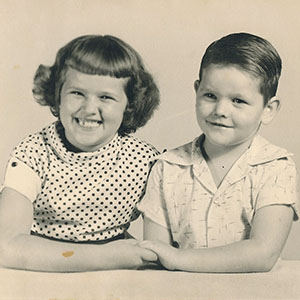 Nedra and her brother Dennis (1950-2026) were beautiful children and must have been J.E. and Betty's pride and joy.
.jpg) Nedra attended the Rockdale County public schools. To use an expression that I learned from her, she was a "cutie patootie." Looking at these school photos, I see her impish smile (far left) and sweet disposition (near left).
Nedra attended the Rockdale County public schools. To use an expression that I learned from her, she was a "cutie patootie." Looking at these school photos, I see her impish smile (far left) and sweet disposition (near left).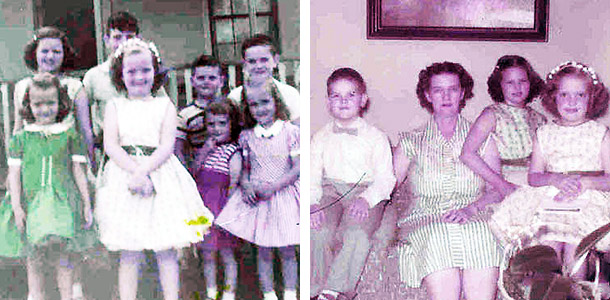 far left of the second panel was] made in front of my childhood home on Highway 20 in Rockdale County, Georgia. At this time, the porch was still screened, having later been changed into a sunroom. Back row: Me, Vic Davis (next-door neighbor), Dennis Norton (my brother), Jimmy Laird (Uncle Pete and Aunt Gladys' son). Front row: Pat Laird, Mariah Kiser [her mother's half-sister], Janet Laird, and Judy Laird. I expect Aunt Gladys made her daughters' dresses, as she usually did. She was known to stay up all night finishing dresses for the girls to wear the next day. I am wearing orthopedic shoes, which were bought for me when I was in the third grade, so that defines the date of these photos." Nedra had flat feet, one of many challenges that manifested later.
.jpg) Nedra expressed delight when her younger brother, Brian S. Norton (1959-2005), was born. In this image (far left), they are sitting in a chair re-uphostered by the Nortons, who then had an uphostery shop.
Nedra expressed delight when her younger brother, Brian S. Norton (1959-2005), was born. In this image (far left), they are sitting in a chair re-uphostered by the Nortons, who then had an uphostery shop.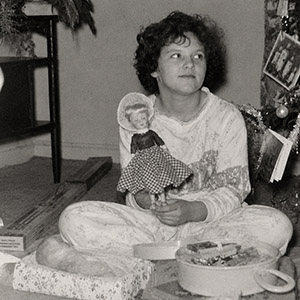 The Rockwellian image, left, caps off her Elementary School years. It evokes the innocence of childhood at Christmas, the elegance of simplicaity and is one of my favorite photographs of her.
.jpg) High-school years comprise a formative period in the lives of most young Americans when influence of peers increases. Many paths can lead to a fulfilling life; highlights of hers are here. During this period, she prepared for university studies, acquired new skills, contributed to her school and matured socially. We look at her family/friends first, then move on to Rockdale High School.
High-school years comprise a formative period in the lives of most young Americans when influence of peers increases. Many paths can lead to a fulfilling life; highlights of hers are here. During this period, she prepared for university studies, acquired new skills, contributed to her school and matured socially. We look at her family/friends first, then move on to Rockdale High School.
.jpg) At Rockdale High, Nedra's sense of responsibility and reliability showed early. The image (left) shows that she and her friend Ricky Almand (dec.) were presented with a Citizenship Award. Nedra was on the yearbook staff for several years and Ricky was the editor (and STAR Student) during their senior year. I did not know Ricky, but Nedra spoke fondly of him and one of my Conyers contacts volunteered that he was a "nice guy."
At Rockdale High, Nedra's sense of responsibility and reliability showed early. The image (left) shows that she and her friend Ricky Almand (dec.) were presented with a Citizenship Award. Nedra was on the yearbook staff for several years and Ricky was the editor (and STAR Student) during their senior year. I did not know Ricky, but Nedra spoke fondly of him and one of my Conyers contacts volunteered that he was a "nice guy." .jpg)
.jpg) Nedra's high-school friends were important to her. We drove from Missouri for a reunion and she was presented a "prize" for greatest distance traveled.
Nedra's high-school friends were important to her. We drove from Missouri for a reunion and she was presented a "prize" for greatest distance traveled..jpg)
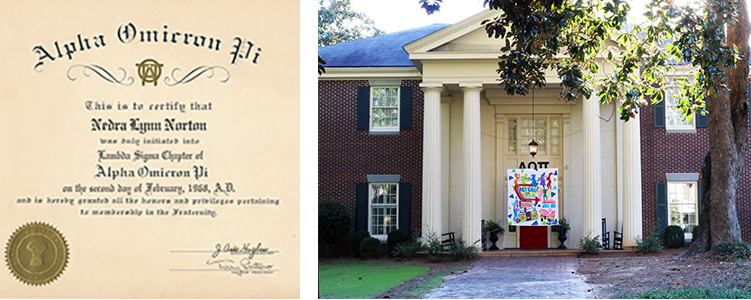 Nedra was inducted into the Alpha Omicron Pi Sorority (far left), which was a pivotal event in her university experience, and indeed her life. She cared deeply for many of her sisters and maintained contact with them until she died. Her house mother was one of her favorite people. The sorority house (right in the panel above), located at the end of Greek Row near Five Points, was her home for much of her Georgia time and is where she lived when we got back together. A common thread in Nedra's life was service to others; in her sorority, she was Activities Chairman and had other responsibilities.
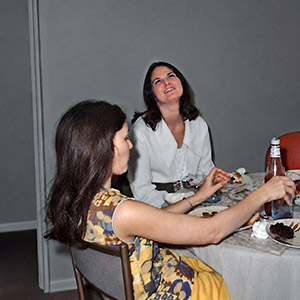 t was like a practicum, and you were graded on everything,” Ann said. “You planned the meals, bought the groceries and kept up with the money, and it was to the penny. If you had 76 cents left over for your week, you turned it in.” The faculty member in charge, Mrs. Jenkins, dropped in at any time, and had a planned meal once a week at each house. The image of Nedra, left, is thought to have been made in the home management house.
.jpg)
 I fell in love with Nedra on first sight, as I’ve said many times (e.g. Mother's Day Card, 2020, at left). She was the most feminine creature I had ever seen. The essence of beauty. I loved everything about her, her soft skin, her poise, her reserved behavior, her sweet demeanor, . . . . I was smitten. A day didn't pass since my first meeting her that I did not think of her. I am ashamed that I was immature, self-centered, way too rowdy for a girl of her nature, and generally not respectful. I did not know
.jpg) As mentioned, Fate had a second shot at uniting us, and this time, it worked (though, actually, I had not matured enough). I called Nedra in late spring, 1970, and she agreed to go out with me. On our first date, she prepared Country Captain, which became my favorite dish (and which Will and Harrison made for our intimate family dinner at the farm following her death).
As mentioned, Fate had a second shot at uniting us, and this time, it worked (though, actually, I had not matured enough). I called Nedra in late spring, 1970, and she agreed to go out with me. On our first date, she prepared Country Captain, which became my favorite dish (and which Will and Harrison made for our intimate family dinner at the farm following her death). .jpg) Love was in the air!
Love was in the air!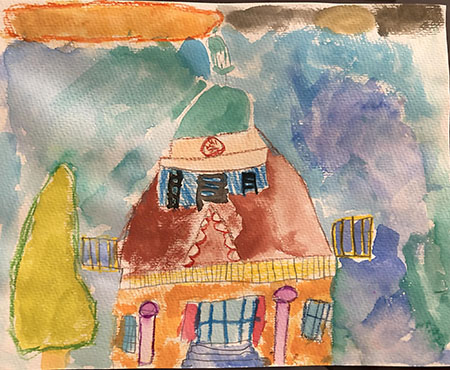 I don’t recall that Nedra and I ever discussed getting married; we both just took it as an article of faith that we would. I fell in love with her at first sight when she was a freshman at UGA and we dated for some while before she broke it off for more good reasons than I care to say, as mentioned earlier. After we rekindled, we soon became exclusive. She graduated from UGA in the spring of 1970 and moved to Decatur and worked for a home decorating company. During that period, she visited with me and sometimes I went to Decatur, stayed with my sister, Carolyn, and we would see each other that way. She returned to Athens for Winter term, 1971, to begin graduate work (and be with me) and shared an apartment with Marilyn Sloan and other sorority sisters, but they saw less of her than I did.
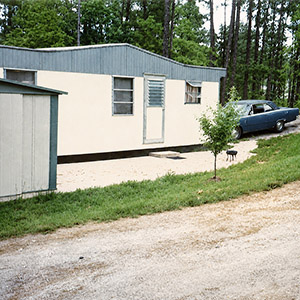 Nedra started a job and we married in September, 1971. At the time, I was a graduate student in plant biology and in an active army reserve unit following my two-year army hitch. My lab work weekday was 7:30 am-9:30 pm with a 2-h break to come home, warm our dinner and eat together. On the weekends, I was in the lab on Saturday until 2:30 pm. Nedra spent most of her private time alone at home (left, a 12x47' mobile home on a rented lot). My sister, Carolyn, gave her a used b/w TV with rabbit ears to take the chill off lonliness.
.jpg) As alluded to, Nedra secured a position as a home-economics teacher in Hartwell, Georgia (left panel). With her 80-mile drive each day and often having to stay late for a function, Nedra was pushed to her limit too.
As alluded to, Nedra secured a position as a home-economics teacher in Hartwell, Georgia (left panel). With her 80-mile drive each day and often having to stay late for a function, Nedra was pushed to her limit too. _red..jpg) Determination defined Nedra. Through evening and weekend classes, she earned a master's degree. The front page of her research paper is shown at left. Putting the paper itself together was an all-hands-on-deck affair. I typed the paper on a manual Underwood typewriter and prepared the figures with a borrowed LeRoy Lettering Set. (How things have changed!) My sister, Carolyn, came from Decatur and supervised and even proof-read.
Determination defined Nedra. Through evening and weekend classes, she earned a master's degree. The front page of her research paper is shown at left. Putting the paper itself together was an all-hands-on-deck affair. I typed the paper on a manual Underwood typewriter and prepared the figures with a borrowed LeRoy Lettering Set. (How things have changed!) My sister, Carolyn, came from Decatur and supervised and even proof-read. _red.jpg) I completed my degree in 1974 and remained in Don Fisher's lab for about a month to reach a stopping point on a side project. AI notes that Don pioneered innovative methods
I completed my degree in 1974 and remained in Don Fisher's lab for about a month to reach a stopping point on a side project. AI notes that Don pioneered innovative methods 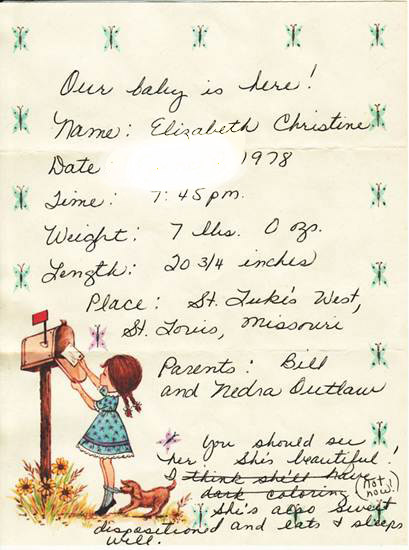 was the surname of Bill’s 2d greatgrandfather; Elizabeth might remember that we visited his grave and had a personalized tour of his home, which had been moved to Brewton-Parker College, founded by Bill’s family, in Mount Vernon, GA.
.jpg) Will first left home, in Fall 1993, to attend the College of William and Mary, from which he earned an A.B. in Classics and a minor in Chemistry in Fall 1995. He immediately returned to Florida State, where he had previously taken undergraduate and graduate courses while he was in high school and earned a degree in Biological Sciences (Spring 1997), while working part-time as a nursing aide at South Georgia Medical Center-Berrien . His final degree program, 2001, was at the University of Florida (image at left), which was followed by three years of residency (Internal Medicine, 2004), three years of fellowship (Gastroenterology, 2007) and one year of Advanced Endoscopy (2008), all at Wake Forest University. At this writing (2026), Will is a partner at Eagle Gastroenterology in Greensboro, NC.
Will first left home, in Fall 1993, to attend the College of William and Mary, from which he earned an A.B. in Classics and a minor in Chemistry in Fall 1995. He immediately returned to Florida State, where he had previously taken undergraduate and graduate courses while he was in high school and earned a degree in Biological Sciences (Spring 1997), while working part-time as a nursing aide at South Georgia Medical Center-Berrien . His final degree program, 2001, was at the University of Florida (image at left), which was followed by three years of residency (Internal Medicine, 2004), three years of fellowship (Gastroenterology, 2007) and one year of Advanced Endoscopy (2008), all at Wake Forest University. At this writing (2026), Will is a partner at Eagle Gastroenterology in Greensboro, NC..jpg) Elizabeth first left home in Fall, 1996, to attend the the University of Georgia. Elizabeth's path had interesting detours. When she was a rising senior, she and a high-school friend, Beverly Bowers, took off to London, no job and no lodging. I aged 10 years that summer. She did get a job, at Accounts Payable, The Montague on the Gardens. Elizabeth completed her A.B. in Anthropology with a minor in French, Spring, 1999. Another opportunity presented itself: she was awarded the position of assistante d'anglais by Le Ministère de l'Éducation Nationale in France to teach English lessons in 5th grade and middle schools throughout Élancourt, a small suburban town near Paris. As discussed later, Nedra visited with her there for several weeks. Like Will, Elizabeth returned to her mom's hearth and earned a masters in Elementary Education at FSU (while teaching French at Lincoln High School). Upon graduation, she returned to live in Athens and teach at North Jackson Elementary School for three years during which time she earned an Ed.S. degree in Educational Leadership and Policy Studies at the University of Alabama. She completed her studies at the College of William & Mary where she earned a Ph.D. with Honors, Educational Policy, Planning, and Leadership.
At this writing (2026), Elizabeth is a professor at the University of North Carolina-Wilmington and a consultant for the World Bank.
Elizabeth first left home in Fall, 1996, to attend the the University of Georgia. Elizabeth's path had interesting detours. When she was a rising senior, she and a high-school friend, Beverly Bowers, took off to London, no job and no lodging. I aged 10 years that summer. She did get a job, at Accounts Payable, The Montague on the Gardens. Elizabeth completed her A.B. in Anthropology with a minor in French, Spring, 1999. Another opportunity presented itself: she was awarded the position of assistante d'anglais by Le Ministère de l'Éducation Nationale in France to teach English lessons in 5th grade and middle schools throughout Élancourt, a small suburban town near Paris. As discussed later, Nedra visited with her there for several weeks. Like Will, Elizabeth returned to her mom's hearth and earned a masters in Elementary Education at FSU (while teaching French at Lincoln High School). Upon graduation, she returned to live in Athens and teach at North Jackson Elementary School for three years during which time she earned an Ed.S. degree in Educational Leadership and Policy Studies at the University of Alabama. She completed her studies at the College of William & Mary where she earned a Ph.D. with Honors, Educational Policy, Planning, and Leadership.
At this writing (2026), Elizabeth is a professor at the University of North Carolina-Wilmington and a consultant for the World Bank..jpg)
.jpg) Elizabeth and John had a small, immediate-family wedding in July 2005 in St. Augustine, Florida, a favorite historic city along the Atlantic Coast. From Tallahassee, Nedra helped Elizabeth plan the wedding by phone, ultimately selecting the St. Francis Inn for both the ceremony and guest lodging. She also helped plan the luncheon menu, including chocolate crêpes especially for John, while Elizabeth created the floral arrangements (a skill she was introduced to through her employment in Gov. Chiles' household in high school, and honed as a designer for Athens Florist when she was in college). The portrait of mother and daughter captures a joyful and loving moment in the hours before the ceremony.
Elizabeth and John had a small, immediate-family wedding in July 2005 in St. Augustine, Florida, a favorite historic city along the Atlantic Coast. From Tallahassee, Nedra helped Elizabeth plan the wedding by phone, ultimately selecting the St. Francis Inn for both the ceremony and guest lodging. She also helped plan the luncheon menu, including chocolate crêpes especially for John, while Elizabeth created the floral arrangements (a skill she was introduced to through her employment in Gov. Chiles' household in high school, and honed as a designer for Athens Florist when she was in college). The portrait of mother and daughter captures a joyful and loving moment in the hours before the ceremony.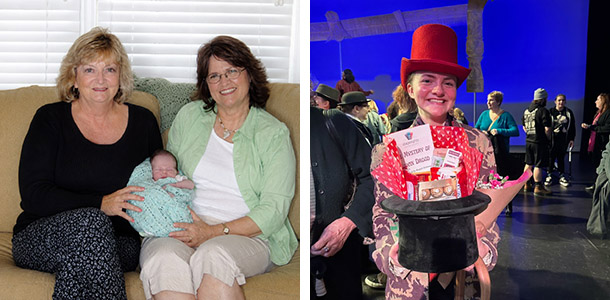
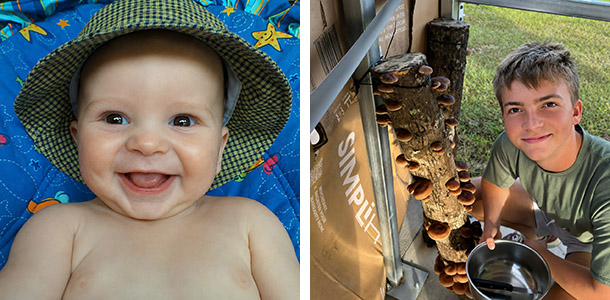 Nedra's second grandchild and Will's second child, Harrison arrived in 2009. Harrison attends Northern Guilford High School and is passionate in all he does, as attested to by his involvement in soccer (three times with a broken collar bone, and structural tears in his legs). Harrison is shown at far-left as a toddler, and near-left, more recently picking shiitakes at the farm.
 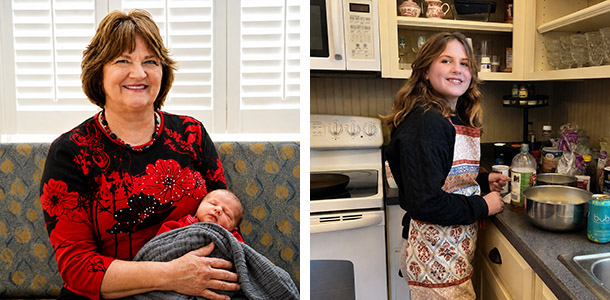 Elizabeth's daughter, Kate, was Nedra's third and final grandchild. In the far-left, newborn Kate, born in 2013, is being held by Nedra.
 400x300.jpg) Dogs identified Nedra as trustworthy. Ancestors of present-day large working dogs were subject to intense pressure during domestication to evaluate human individuals to determine whether a person is "good" or "bad." Google AI expresses it thusly, "
Dogs identified Nedra as trustworthy. Ancestors of present-day large working dogs were subject to intense pressure during domestication to evaluate human individuals to determine whether a person is "good" or "bad." Google AI expresses it thusly, "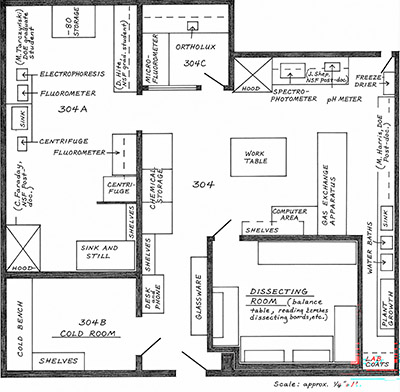 At the risk of a negative connotation, I would characterize her as my 'Girl Friday.' She handled everything without drama—whether tracking down a lost order, expediting a document faster than campus mail, sourcing an item locally, providing fiscal oversight, or offering sound advice regarding new hires.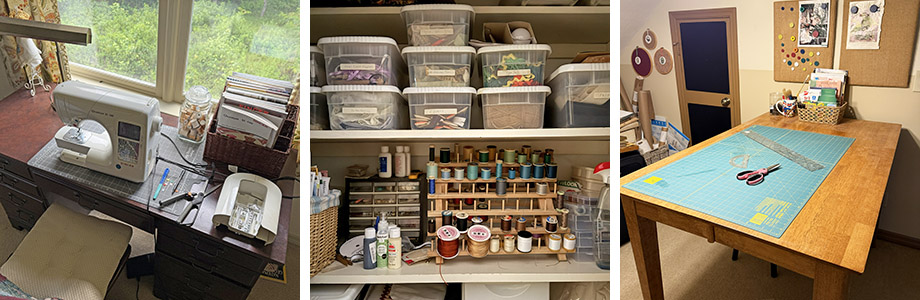
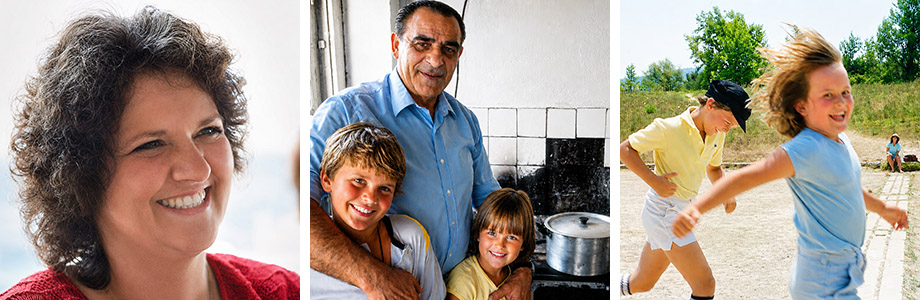
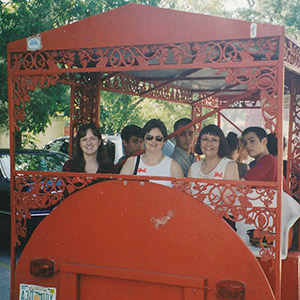 As alluded to earlier, Nedra visited with Elizabeth near Paris for several weeks in November and December, 1999. They had a wonderful time exploring Paris, staying in La Maison Favart, touring Chartres with Elizabeth’s French teacher friends, and having a very special excursion, just the two of them, to Auvers-sur-Oise, van Gogh’s final residence and resting place. Nedra’s handwritten spiral notebook recorded purchasing souvenirs like faïence (235 F) and van Gogh gifts (514 F).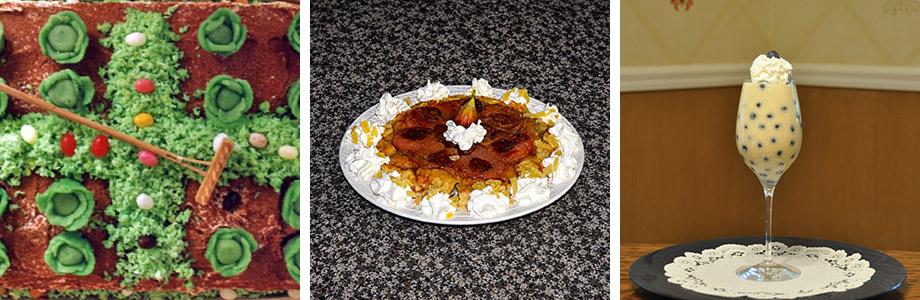
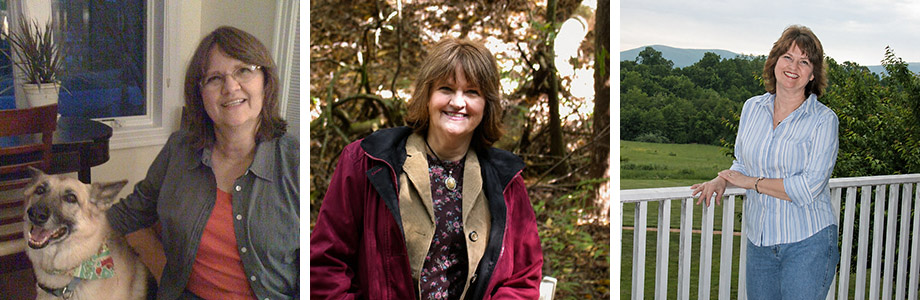
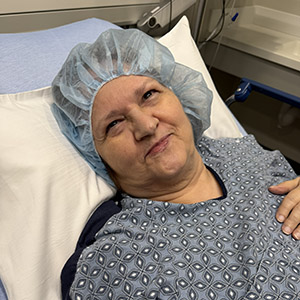 Nedra had a flow diverter placed to "cure" her aneurysm on June 4, 2025. As part of the preparation, a P2Y12 assay (for platelet aggregation) was run to determine the efficacy of the Plavix she had been given. The results indicated that Plavix was not protective. so her team prescribed Brilinta at the usual dosage for this application of 90 mg, twice per day, with once daily aspirin. Difficulties were encountered in placement of the flow diverter, but in the end, it was properly installed. Nedra's spirits were high--Elizabeth had come a couple of days early to support us, and Nedra had made her a birthday cake; it was Nedra's last cake, but none of us suspected it.We thought our troubles were behnd us.
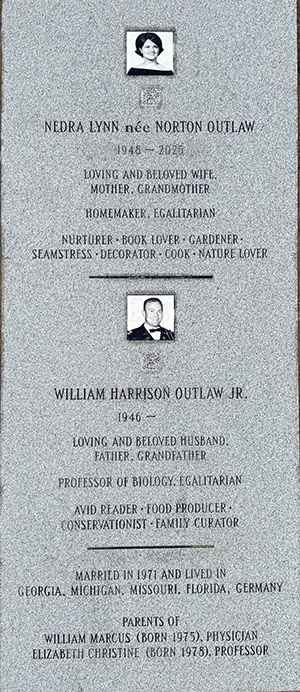 In July, 2026, our joint ledger was placed 12" east of my father's and connected with coping and stone. QR codes link to this page (and to Bill's Story in the future.)