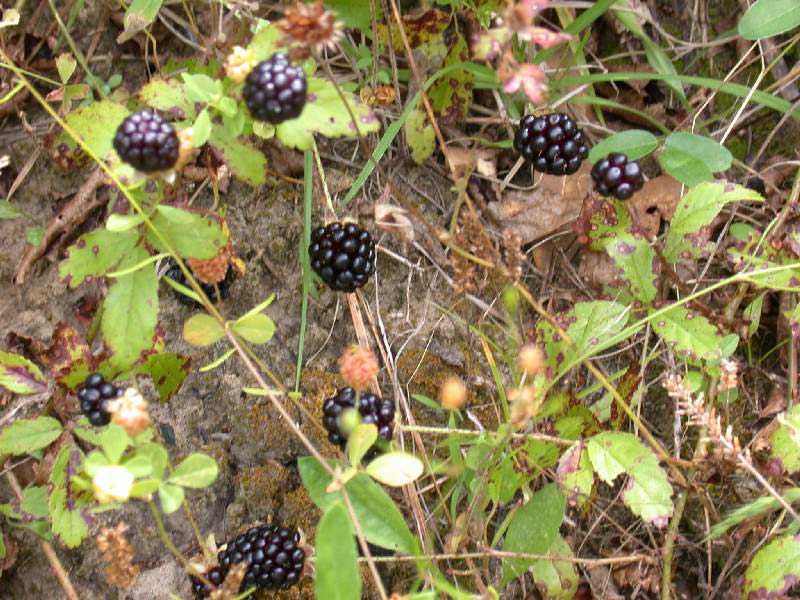
 Blackberry, dewberry, raspberry, bramble (Slide
2 and background, Rubus trivialis Michx., the Southern Dewberry; see Rubus cuneifolius Pursh. (Sand Blackberry); see Rubus betulifolius Small (Highbush Blackberry)).
In the Rose Family, Rubus is a taxonomically diverse and difficult
genus with up to 250 species (Mabberly's The Plant Book (1987))
and a corresponding degree of morphological variation. Many are edible
and are readily identifiable as "blackberries," as these are called
in the South. These plants often occupy margins, such as fence rows,
and areas in succession, such as planted pines. The first-year canes
do not fruit; second-year canes fruit and die back. Thus, a two-year
cycle is required for fruit production. In former days--when domestic
livestock were fenced in (or out) and widespread use of herbicides had
not debuted--blackberries, thriving in a habitat loved by quail, were
abundant in accessible locations. Then, literally buckets of the berries
could be had for the picking in a good year. It was not uncommon for
a family, but mostly women and children, to go on a foraging party;
if one elected not to join the party, she sent a clear signal that she
didn't "fit in" . Foraging parties were
all before the age of cheap plastics, inexpensive imports, and much
disposable income, so the fastest pickers had the choice of buckets
and children were supplied with cloth sacks, rather like small pillowcases
with shoulder straps. (Although it strays from the point somewhat, flour
came in small cloth sacks that could be used directly or could be reassembled
into clothing.) Picking berries had its drawbacks. Of course, there
were scratches and getting loaded with chiggers in the most inconvenient
locations was a given. Snakes, though, were the biggest worry and farm
women had a hysterical fear of snakes. (The one thing my mother never
forgave me for was walking into her kitchen with a snake wrapped around
my arm; it was almost the end of dear Aunt Bessie.) This fear was well-rooted,
however--a child was killed on our farm by a rattlesnake in the 1930s,
and a tenant was bitten by one in the corn crib one night. But the fear
of snakes by women was balanced by the bravado of young men, like my
mother's late brother Sam, who would catch a snake by its tail, swing it
overhead in a circle, and with a quick snap of the wrist, send its head
flying. Anyhow, picking berries had its rewards, to be sure. Granny
Watson made mounds of tarts, berries in a sweet gooey base folded in
thin dough, and deep-fat fried. Of course, a couple of cases of jelly
were put up, real jelly made from wild berries and hard work, resembling
only in name the factory foods sold by the big-box superstores. I carry
on this tradition, but more modestly: Nedra and I make a wild blackberry
crisp each spring. If I really behave myself, I am subject to a blackberry pie. (Thanks to Loran Anderson for identifying the species
in this slide and who opined that R. trivialis is perhaps the
best tasting of our native blackberries. Loran also mentioned that some are sensitive to Rubus spp., which causes them to have a rash. Also, thanks to Jean Burns
Moriuchi for herbarium assistance.)
Blackberry, dewberry, raspberry, bramble (Slide
2 and background, Rubus trivialis Michx., the Southern Dewberry; see Rubus cuneifolius Pursh. (Sand Blackberry); see Rubus betulifolius Small (Highbush Blackberry)).
In the Rose Family, Rubus is a taxonomically diverse and difficult
genus with up to 250 species (Mabberly's The Plant Book (1987))
and a corresponding degree of morphological variation. Many are edible
and are readily identifiable as "blackberries," as these are called
in the South. These plants often occupy margins, such as fence rows,
and areas in succession, such as planted pines. The first-year canes
do not fruit; second-year canes fruit and die back. Thus, a two-year
cycle is required for fruit production. In former days--when domestic
livestock were fenced in (or out) and widespread use of herbicides had
not debuted--blackberries, thriving in a habitat loved by quail, were
abundant in accessible locations. Then, literally buckets of the berries
could be had for the picking in a good year. It was not uncommon for
a family, but mostly women and children, to go on a foraging party;
if one elected not to join the party, she sent a clear signal that she
didn't "fit in" . Foraging parties were
all before the age of cheap plastics, inexpensive imports, and much
disposable income, so the fastest pickers had the choice of buckets
and children were supplied with cloth sacks, rather like small pillowcases
with shoulder straps. (Although it strays from the point somewhat, flour
came in small cloth sacks that could be used directly or could be reassembled
into clothing.) Picking berries had its drawbacks. Of course, there
were scratches and getting loaded with chiggers in the most inconvenient
locations was a given. Snakes, though, were the biggest worry and farm
women had a hysterical fear of snakes. (The one thing my mother never
forgave me for was walking into her kitchen with a snake wrapped around
my arm; it was almost the end of dear Aunt Bessie.) This fear was well-rooted,
however--a child was killed on our farm by a rattlesnake in the 1930s,
and a tenant was bitten by one in the corn crib one night. But the fear
of snakes by women was balanced by the bravado of young men, like my
mother's late brother Sam, who would catch a snake by its tail, swing it
overhead in a circle, and with a quick snap of the wrist, send its head
flying. Anyhow, picking berries had its rewards, to be sure. Granny
Watson made mounds of tarts, berries in a sweet gooey base folded in
thin dough, and deep-fat fried. Of course, a couple of cases of jelly
were put up, real jelly made from wild berries and hard work, resembling
only in name the factory foods sold by the big-box superstores. I carry
on this tradition, but more modestly: Nedra and I make a wild blackberry
crisp each spring. If I really behave myself, I am subject to a blackberry pie. (Thanks to Loran Anderson for identifying the species
in this slide and who opined that R. trivialis is perhaps the
best tasting of our native blackberries. Loran also mentioned that some are sensitive to Rubus spp., which causes them to have a rash. Also, thanks to Jean Burns
Moriuchi for herbarium assistance.)
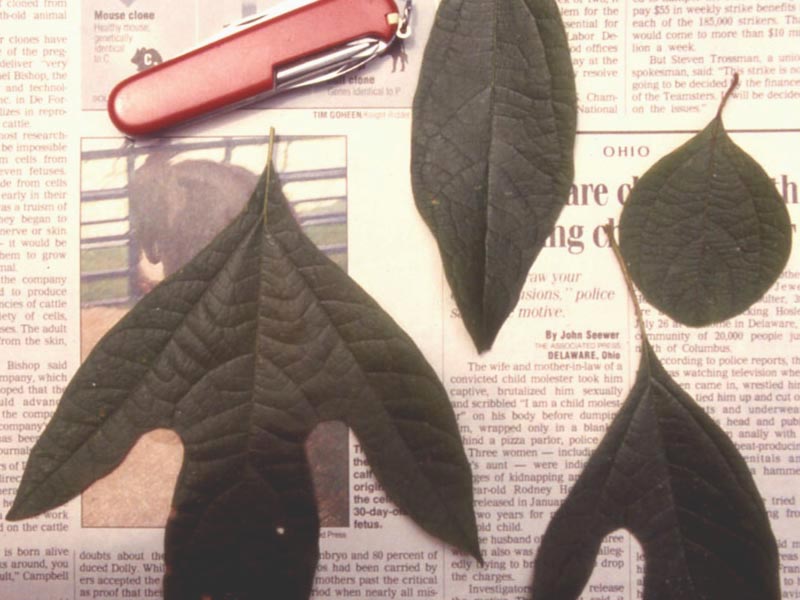
 Sassafras (Slide 3,
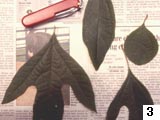
Sassafras albidum Nutt.) has a highly variable leaf morphology, even within a single plant.
Loran Anderson explains that entire leaves are formed in spring, lobed leaves in summer, and entire leaves again in fall. One of his photographs documents this sequential leaf development whereas a second is of rarely seen blooms. Ken Christison rounded out this series by providing a photo of the fruit. Gumbo, an original creation of south Louisiana kitchens, can be thickened either by okra cooked in the “soup” or by filé (powdered sassafras leaves, a creation of the Choctaw Indians) added after the other components are cooked. (See River Road Recipes, 1959, the Junior League, Baton Rouge, LA.) In my part of the South, however, it was more typical to make a dessert beverage by steeping the aromatic roots, a practice that should be discontinued because of the presence of the
carcinogen safrole. Sassafras was even more highly valued as a medicinal, another early tradition, thus: "
The Spaniards did begin to cure themselves with the water of this tree and it did in them greate effectes, that it is almost incredible: for with the naughtie meates and drinkyng of the rawe waters, and slepying in the dews, the most parte of them came to fall into continuall Agues. . . .Thei took up the roote of this Tree and tooke a peece thereof suche as it seemed to theim beste, thei cutte it small into verie thinne and litte peeces and cast them into water at discretion, little more or less, and their sodde it the tyme that seemed nedefull for to remaine of a good colour, and so thei dranke it in the mornyng fastyng and in the daie tyme and at dinner and supper, without keeyng any more waight or measure than I have saied. . .theie were healed of so many griefes and evill diseases, that to heare of them what their suffred and how their wre healed it doeth bryng admiration and their which were whole dranke it in place of wine, for it doeth preserve them in healthe . . . “ (from a 1579 translation in Uses of Plants (1979) Erichsen-Brown, Breezy Creek Press). As a personal example of sassafras' medical usage, I recall that my maternal grandfather regularly drank sassafras-infused whiskey for his severe arthritis, but I have always wondered if it might have been a means to have a nip even under the watchful eyes of Granny Watson. I say this because he shared sips with me, and it was a very long time before I developed arthritis. Indeed, it was even quite some time before I was able to drive legally.
Sassafras (Slide 3,
Sassafras albidum Nutt.) has a highly variable leaf morphology, even within a single plant.
Loran Anderson explains that entire leaves are formed in spring, lobed leaves in summer, and entire leaves again in fall. One of his photographs documents this sequential leaf development whereas a second is of rarely seen blooms. Ken Christison rounded out this series by providing a photo of the fruit. Gumbo, an original creation of south Louisiana kitchens, can be thickened either by okra cooked in the “soup” or by filé (powdered sassafras leaves, a creation of the Choctaw Indians) added after the other components are cooked. (See River Road Recipes, 1959, the Junior League, Baton Rouge, LA.) In my part of the South, however, it was more typical to make a dessert beverage by steeping the aromatic roots, a practice that should be discontinued because of the presence of the
carcinogen safrole. Sassafras was even more highly valued as a medicinal, another early tradition, thus: "
The Spaniards did begin to cure themselves with the water of this tree and it did in them greate effectes, that it is almost incredible: for with the naughtie meates and drinkyng of the rawe waters, and slepying in the dews, the most parte of them came to fall into continuall Agues. . . .Thei took up the roote of this Tree and tooke a peece thereof suche as it seemed to theim beste, thei cutte it small into verie thinne and litte peeces and cast them into water at discretion, little more or less, and their sodde it the tyme that seemed nedefull for to remaine of a good colour, and so thei dranke it in the mornyng fastyng and in the daie tyme and at dinner and supper, without keeyng any more waight or measure than I have saied. . .theie were healed of so many griefes and evill diseases, that to heare of them what their suffred and how their wre healed it doeth bryng admiration and their which were whole dranke it in place of wine, for it doeth preserve them in healthe . . . “ (from a 1579 translation in Uses of Plants (1979) Erichsen-Brown, Breezy Creek Press). As a personal example of sassafras' medical usage, I recall that my maternal grandfather regularly drank sassafras-infused whiskey for his severe arthritis, but I have always wondered if it might have been a means to have a nip even under the watchful eyes of Granny Watson. I say this because he shared sips with me, and it was a very long time before I developed arthritis. Indeed, it was even quite some time before I was able to drive legally.
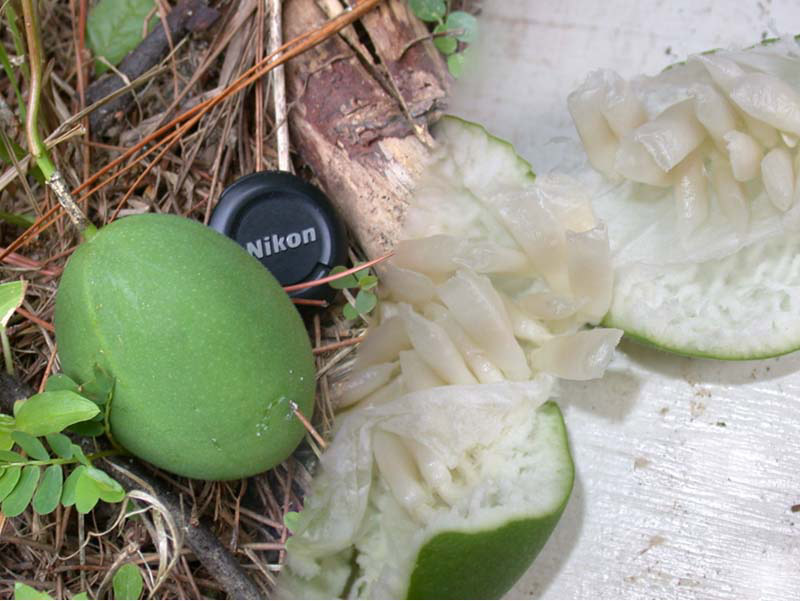
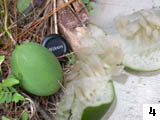 Maypop (Slide 4, Passiflora incarnata L.) is not a forage plant per se, but it is a target of opportunistic grazing by Americans of various stripes, including Southerners. When the berry is mature in late summer (Slide 4), the jelly-like pulp that suurrounds the seeds, albeit limited, has a pleasant flavor. Maypop tolerates drought well and is common in old fields and along forest margins. Like sassafras, above, the leaves along the plant are of different shape, but it is easily identified, especially by the striking flower (which through Christian interpretation provides the family name, Passion Flower, as shown by this Ken Christison image). Interestingly, maypop has 1-2 mm extra-floral nectaries at the base of leaves; these nectaries secrete a solution of sugars and amino acids. Insects attracted by the secretion protect maypop from predators.
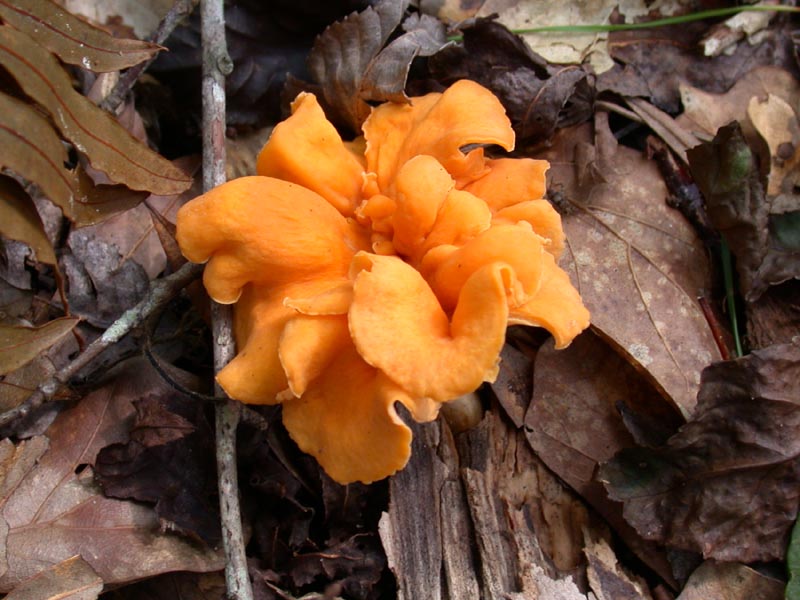
Chanterelle (Slide 5, Cantharellus spp., esp. C. cibarius Fr.; see also side view;). Notwithstanding that the yeomanry stock I stem from would not eat a mushroom in any shape, form, or fashion, I include one here because of the interest I developed late in life that resulted from three circ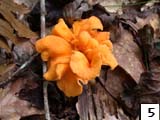 umstances -- a chance encounter with a commercial collector, an enthusiastic student (Chris Caleen), and chanterelle patches in the edge of my woods. A choice native edible, the chanterelle in the southern U.S. is usually most abundant in late summer when it is hot and wet, but it might appear as late as December, too. They are often found along breaks in mixed stands of hardwoods (such as oaks, beeches, and hickories) and pines (both groups with which it is mycorrhizal). Lacking true gills, the fertile surfaces on the underneath of the fruiting body are blunt, shallow, branching, even webbed, nominal 1-mm-wide ridges that run down the stalk. Flesh is whitish or slightly yellow, especially just under the surface. Cap and stalk are yellowish to yolk-colored. Stalk is solid. Cap morphology is variable, from simple to complex and ruffled (as shown in these ready-to-wash specimens). Cap is smooth-surfaced and, at least on older specimens, concave and the margin is wavy or broken. This brief narrative does not serve as a guide to identification, but merely emphasizes the importance of distinguishing this mushroom from look-alikes particularly the poisonous jack-o’lanterns (Omphalotus spp, which has true “blade-like” gills that do not branch, which has an entire or broken margin on the cap and orange-yellow-colored flesh, and which is saprophytic or parasitic and likely to grow in clusters) and the false chanterelle (Hygrophoropsis aurantiaca, also non-mycorrhizal, which is more common in the upper South than around Tallahassee, whose toxic properties seem uncertain and which has a hollow stalk, true gills that are dichotomously branched, even near the stalk, and a cap that often has a dingy brownish center). As a means of savoring their flavor, chanterelles are often simply sautéed and served over a relatively bland starchy food, like this cornbread made from Marcus Walker’s meal. (Thanks to Bill Petty for helpful comments that were used in editing the narrative and to Kim Riddle and Ken Womble for macrophotography. The following references were used in preparation of the narrative: D. Arora 1986 Mushrooms Demystified. Ten Speed Press, Berkeley; T. Laessoe, A. Del Conte, G. Lincoff 1996 The Mushroom Book. DK Publishing, New York; G. H. Lincoff 1981 National Audubon Society Field Guide to North American Mushrooms. Chanticleer Press, New York; G. Pacioni 1981 Guide to Mushrooms. Simon and Schuster, New York; N.S. Weber, A.H. Smith, D. Guravich 1985 A Field Guide to Southern Mushrooms. University of Michigan Press, Ann Arbor.)
Cabbage palm, sabal palm, swamp cabbage (Slide 6, Sabal palmetto). What a terrific day I had with Michael and A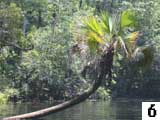 ndy Barrineau, who guided me to the wonderful Aucilla River! (For complete disclosure, the icon image, the Tarzan Tree, was made on the Wakulla River, near the spring.) Andy was a member of a hunting club, which had exclusive rights to a large tract. A road was planned to cut a swath through one area and Andy graciously agreed to "help" me cut an already condemned swamp cabbage. My home, 100 miles to the northeast, doesn't support the growth of this species, but I had heard of eating it all my life. The words of the late Zack Hicks echoed in my mind ("I was practically raised on swamp cabbage.") Andy located a tree of suitable size and the terminal bud was removed. I prepared the "cabbage" and Nedra cooked it in the traditional way, boiled down with pork. Though edible, it is bland and not particularly delicious, a fortunate circumstance as harvesting the bud is lethal to the plant.
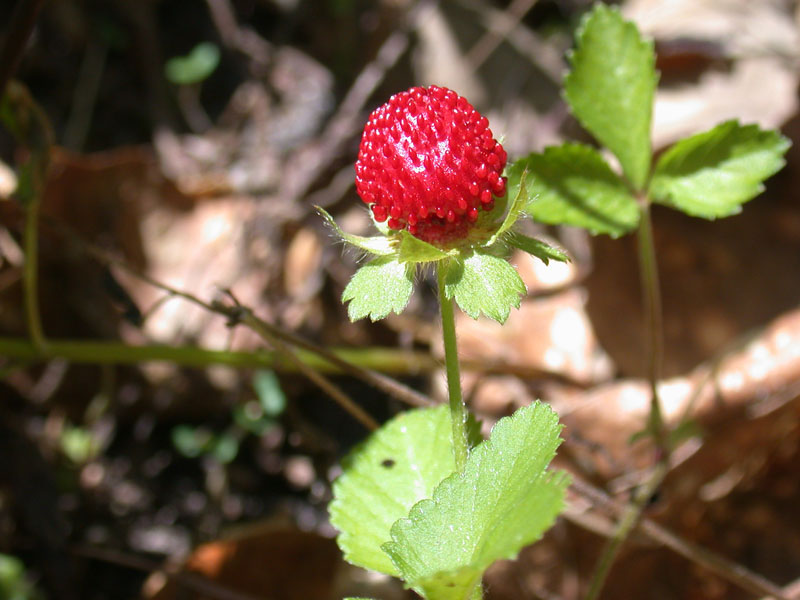
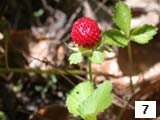 Mock strawberry, Indian strawberry [from the country of India] (Slide 7, Duchesnea indica (Andr.) Focke; see also several synonyms) This Asian weed has a southeastern range that extends down into north Florida, where the real strawberry (Fragaria spp.) is rare or absent. Though edible, the mock strawberry is bland and will be a certain disappointment to one who expects the semi-sweet tart flavor of a strawberry. (This narrative relied on Bell C.R & B.J. Tarylor (1982) Florida Wild Flowers and Roadside Plants. Laurel Hill Press, Chapel Hill and several www sites.)
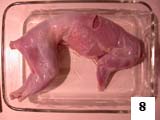 Squirrel (Slide 8, Sciurus carolinensis) Squirrels have been around for about 50 million years and, aside from serving as dog food, have little value. They and their rodent cousins, rats and mice, were placed on Earth primarily to antagonize. Indeed, they are my sworn enemy and deprive me of the harvests that should rightly be mine (I plant, cultivate, fertilize, pay taxes, and squirrels steal). There is no such thing as a squirrel repellant--they don't mind rotten eggs, panty hose with fish entrals, nothing will keep them off fruit and nuts except for lead, and it has to be traveling pretty fast. Time was, though, when squirrels had value to me. As a youngster, I enjoyed hiding in the woods at the edge of the pecan orchard and shooting them. Our farm house was vacant, but fully furnished, and was a haven for young boys with enough dressed squirrels, grease, and a frying pan. Those were simple times, when it seems that being good was rewarded, and I miss that. In my seventh decade, the question arose, can squirrels once again be of some direct value to me? The answer, in brief, as I will portray, is yes, somewhat, if one has the time and interest. Honestly, would you believe that "In terms of number of hunters and harvest, squirrels are the number two small game species in Georgia behind doves. During the 2002-2003 hunting season, 65,000 hunters harvested 803,000 squirrels." (ref) Anyhow, the skin of a freshly killed squirrel is removed and the squirrel is opened (both procedures without puncturing the various internal parts). The resulting carcass resembles meat, recognizable to 21st-century Americans. From this point, there are several directions one might take. On this day, I determined to make squirrel burgoo (Hoppin John's Lowcountry Cooking, John Martin Taylor, Bantam, New York 1992) and browned the squirrel before preparing the final dish. Delicious, I think, with a smile. One fewer squirrel, one more meal. (btw, spouse Nedra was none the wiser about this, as other activities conducted in her absence. More said by her would not stabilize our relationship.)
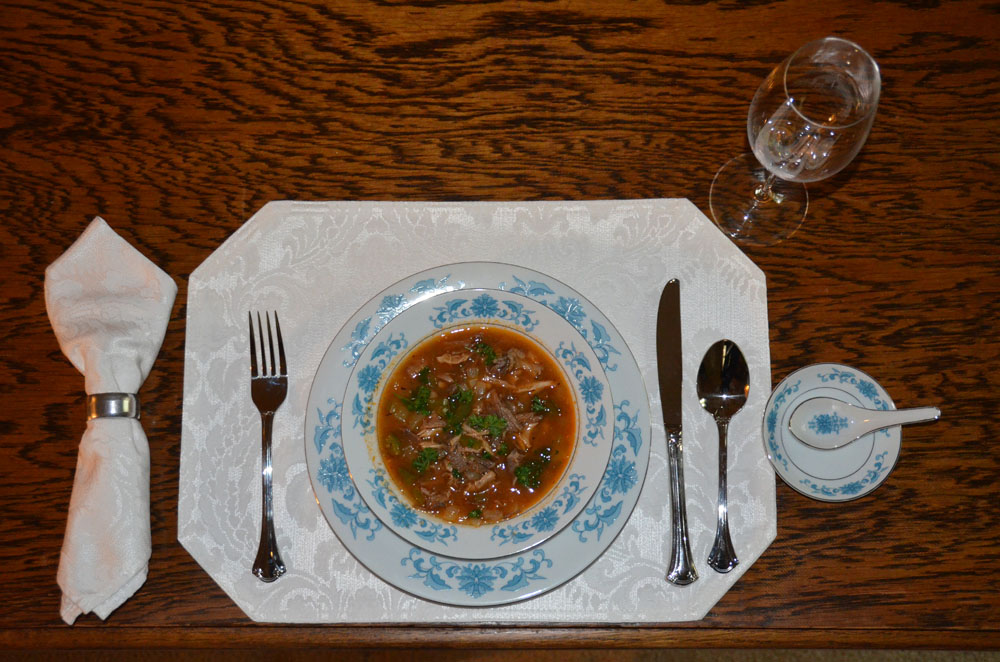
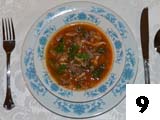 Softshell Turtle (Slide 9, Apalone ferox) Several turtle species (gopher tortoise or Hoover chicken, cooters, snapping turtles, and softshells) were consumed by our wiregrass pioneers, but my experience had been third hand ("they said my great granddaddy . . . .), which was a little too far away for my sensibilities. The gopher tortoise is a vulnerable keystone species and should strictly not be bothered; these turtles require 18-20 years to reach sexual maturity and lay only 5-8 eggs, which are preyed on by a variety of critters (ref). Our assaults on this species (loss of longleaf habitat, introduction of exotic fire ants, entombment during construction) justifies efforts to conserve, not consume them, and it is illegal to possess them or parts of them. There are also prohibitions on taking of several other turtles, if only because they are so similar to threatened species. However, both in Georgia and Florida (ref2), it is legal to take softshell turtles, with restrictions. Current commercial exploitation in Florida--mostly for export--is probably not sustainable, but their conservation status as "Least Concern" and the scientific recommendation of one per day per person supported my decision to take one. Softshell turtles are shockingly fast in water (they swim faster than the fish they prey on) and on land (15 mph!). Those facts, considered with their strong jaws and long neck, implies to me that the first order of business is to avoid supplying finger food to this good-sized specimen. Having watched with Nedra an episode of Zimmern with genuine experienced Florida Crackers struggling to open one, I knew that removing the prized meat was not going to be easy. I decided to remove the entrails first to avoid the risk of punctures that might come with the alternative method of harvesting the meat. Recipes abound, and we followed the sound advice of friend Dick Swanson and replicated a soup made by one of his favorite restaurants. Nedra simmered the meat for about 2.5 hours, and then I removed it from the bones and shredded it. Meanwhile, Nedra assembled the other ingredients, based on Cajun Justin Wilson's three favorite ingredients, viz. onion, celery, and pepper plus Dick's favorite part, sherry (he later joked that folks under 21 can't eat Nedra's soup (hehe)). The meal was served up on dishes imported from China before things were imported from China. (In 1991, I had packed up an entire set of dishes in my suitcase in Beijing and they all made the trip back without a scratch, much better than I, being literally desperate with food poisoning--what a l-o-n-g trip!) The soup was enhanced with a dollop of cream and side of hearty bread. Excellent, as it was a sound recipe and executed by Nedra. Surplus for future meals, no food miles, low fat (I scraped all off), no residual antibiotics, no concerns about the quality of life it had, and zero carbon footprint. We'll do it again.
*****Suggestions are welcome.******


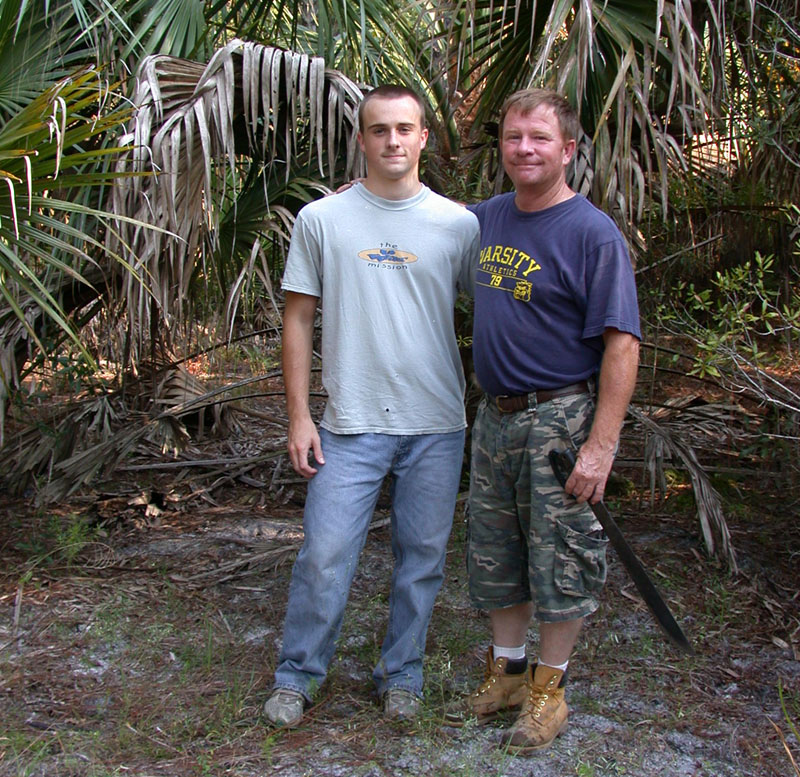 ndy Barrineau